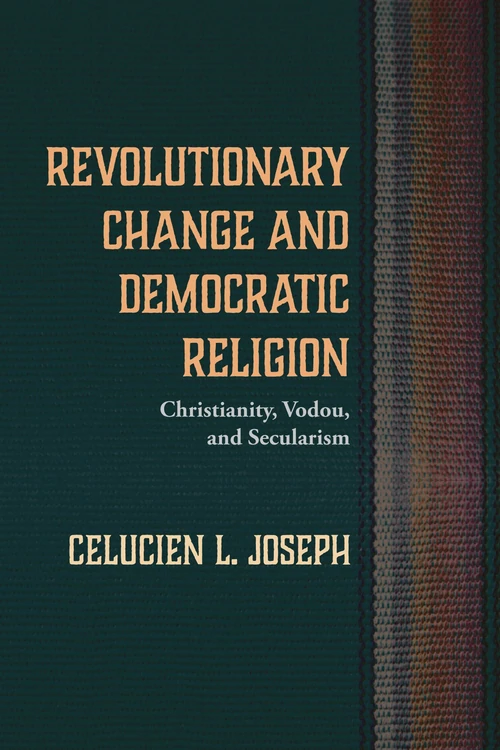
Revolutionary Change and Democratic Religion
Christianity, Vodou, and Secularism
- World Religions
- History & Biography
- Publisher: Pickwick Publications (Wipf and Stock)
- Published: 2020
FritzSearch.com earns a commission on purchases made through Bookshop.org links.
Publisher's Description
In Revolutionary Change and Democratic Religion, Celucien Joseph provides a fresh and careful reexamination of Haiti's intellectual history by focusing on the ideas and writings of five prominent thinkers and public intellectuals: Toussaint Louverture, Joseph Antenor Firmin, Jacques Roumain, Dantes Bellegarde, and Jean Price-Mars. The book articulates a twofold argument. First of all, Haiti has produced a strong intellectual tradition from the revolutionary era to the postcolonial present, and that Haitian thought is not homogeneous and monolithic. Joseph puts forth the idea that the general interweaving themes of rhetoric, the race concept, race vindication, universal emancipation, religious pluralism, secular humanism, the particular and the universal, and cosmopolitanism are representative of Haiti's intellectual tradition. Secondly, the book also contends that Haitian intellectuals have produced a religious discourse in the twentieth century that could be phrased religious metissage. The religious ideas of these thinkers have been shaped by various forces, ideologies, religious traditions, and philosophical schools. In the same way, the religious experience of the Haitian people should be understood in terms of conflicting, heterodox, and pluralistic manifestations of religious piety, as the people in Haiti reacted to the crisis of slavery, Western colonialism and imperialism, and the arrogance of race in modernity in their striving to reposition themselves within the framework of universal and human metanarratives. The book departs from the dominant (contemporary) Vodou scholarship that is often characteristic of North American and Western studies on the religious life of the Haitian people and Haitian thinkers.
Endorsements (4)
“This provocative book provides an opportunity to reflect on Dr. Joseph’s summaries of historical Haitians and their intellectual understandings of race, politics, religion, and their intersectionality. The book is an opportunity to engage with the role of Haitian religion as intellectual and social praxis from a variety of perspectives.”
“In the tradition of liberation theology, Celucien Joseph’s work, Revolutionary Change and Democratic Religion, marries the metaphysics of religion with dialectical materialist revolutionary social change to offer a utopian vision for society. Although as a metaphysical materialist I disagree with the underlying idealist premise of the work, its utopian vision assuages my opposition enough to offer my endorsement of this worthwhile text.”
“This book offers us an interesting reflection on questions relating to freedom, human dignity, and religious traditions in Haiti. The author examines various works contributing to the development of Haitian thought and in relation to universal and human rights. He also studies different approaches to religion and secularism developed by Haitian authors (Jacques Roumain, Jean-Bertrand Aristide, Laënnec Hurbon, and Jean Fils-Aimé) in a context of social change. It is an important book to offer! It is a book to discover, absolutely!”
“Spanning from colonial Saint Domingue to twenty-first-century Haiti, Revolutionary Change and Democratic Religion re-examines the political and social thought of six influential Haitian thinkers, including Toussaint Louverture, Anténor Firmin, and Jean-Bertrand Aristide. In doing so, it provides an important reconsideration of Haitian intellectual history. As Joseph shows, Haitian thinkers have offered enduring theories of freedom, humanism, history, and social justice. They must be centered in any comprehensive intellectual history of the modern world.”
See something wrong on this page? Report a problem