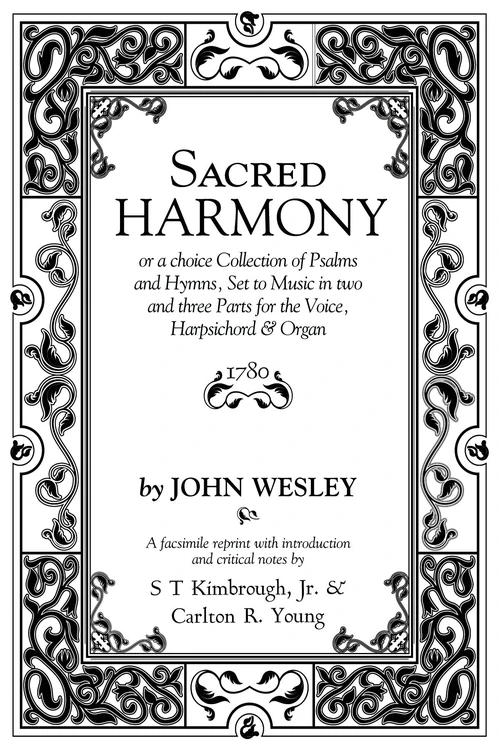
Sacred Harmony
or a choice Collection of Psalms and Hymns, Set to Music in two and three Parts for the Voice, Harpsichord & Organ
- Preaching & Worship
- Publisher: Resource Publications (Wipf and Stock)
- Published: 2020
FritzSearch.com earns a commission on purchases made through Bookshop.org links.
Publisher's Description
John Wesley published three tune books in two-decade intervals for the evangelical British Methodist movement within the Church of England with its varied audiences and diverse musical tastes. S T Kimbrough, Jr. and Carlton R. Young have published the only facsimile reprints, with critical introductions and notes, of the first two collections (1742 and 1761). Wesley intended his third collection, Sacred Harmony, or a choice Collection of Psalms and Hymns, Set to Music in two or three parts for the Voice, Harpsichord & Organ (1780), henceforth SH 1780, as a musical companion to his monumental A Collection of Hymns for the Use of the People Called Methodists (1780). This edition of SH 1780 provides the ecclesial, cultural, and musical contexts of the volume; traces the sources of each tune and text (with textual variants), provides indexes of texts and tunes, and appropriate appendices. The copy used for this facsimile includes the autograph of John Wesley and the date of January 10, 1780, on an opening flyleaf, his marginal notes, and is housed in the archives of Old St. George's United Methodist Church in Philadelphia, Pennsylvania. Each page of this facsimile edition of SH 1780 has been thoroughly cleaned of bleedthrough and blotches.
Endorsements (4)
“Scholars and the public at large have not been aware of Sacred Harmony, published in year 1780 and intended as the musical accompaniment for the 1780 Collection of Hymns for the Use of the People Called Methodists, edited by John Wesley. With this critical facsimile re-publication of Sacred Harmony, we can understand far better how the texts related to the specific tunes that John Wesley prescribed for them. The fact that Wesley moved to including two- and three-part harmony shows his own advancement over the single-line melodies he had favored in the past. This volume is thus an absolutely critical development in the understanding of the evolution of Wesleyan and Methodist hymnody, and a very welcome and accessible addition to our sources for understanding the Wesleyan movement.”
“This volume completes a vital resource for all who are interested in early Methodist worship: access to the tunes commonly used in Britain and beyond. Kimbrough and Young previously issued variorum editions, with introduction and notes, of the “Foundery Collection” (1742) and the tunes in Select Hymns (1761). Sacred Harmony (1780) is the final—and most extensive—set of tunes published by John Wesley for early Methodist worship. This critical edition is based on Wesley’s personal copy, incorporating his manuscript corrections of the published version. It is enriched by introductory remarks placing the collection in context, identifying sources of the tunes, and other matters; as well as a number of appendices. The volume is masterfully produced and highly recommended.”
“This facsimile of and critical commentary on an important Wesleyan tune book is a welcome addition to the publications in this series. It is a special treat to see the original printing and have it—and its contents—explained in so perceptive and thorough a manner. This is the sort of work that we have come to expect from these editors—and we are not disappointed with the results.”
“This edition of Sacred Harmony (1780) sets the standard for annotated facsimile resources. A musical companion to the momentous A Collection of Hymns (1780), the seasoned editorial duo of Kimbrough and Young transform a lesser known eighteenth-century musical document into living sonorities that both link today’s reader directly to the heart of the Wesleys and deepen our understanding of the identity and soul of Methodism.”
See something wrong on this page? Report a problem