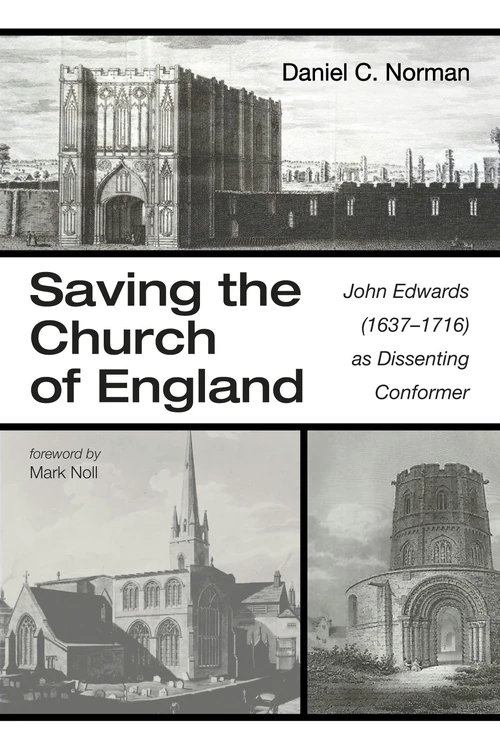
Saving the Church of England
John Edwards (1637–1716) as Dissenting Conformer
- History & Biography
- Publisher: Wipf and Stock
- Published: 2022
FritzSearch.com earns a commission on purchases made through Bookshop.org links.
Publisher's Description
On his second Atlantic voyage, George Whitefield read lengthy quotations from a work of a deceased English cleric. Writing in his journal, he exclaimed, "[These words] deserve to be written in Letters of Gold." Whitefield's associate, the American Jonathan Edwards, concurred. That cleric was John Edwards, an anomaly in several respects: a self-proclaimed Calvinist who conformed to the Church of England at a time when most Calvinists left in the Great Ejection of 1662. In leading a public debate against prominent intellectuals of his day, including John Locke and Samuel Clarke, over the definition of orthodox Christianity, he allied himself with the same church leaders who decried his Calvinist theology. Edwards retired in his mid-fifties due to "ill health"--a retirement in which he wrote over forty scholarly books. At the heart of his concern was the unity and doctrinal orthodoxy of the church, themes over which contentious disputes have reverberated throughout church history. Saving the Church of England tells the story of why the church was in trouble and of John Edwards's heroic effort to save it.
Endorsements (3)
“It is high time for a biography dedicated to this high Calvinist, John Edwards. He is usually dubbed ‘the last of the English Calvinists,’ and you will have to read this work to see if that description is true. Influential for his works on preaching, on pedagogy, on doctrine and polemics, and on the nature of the church, Edwards’s reach was transatlantic and widespread. This work is an overdue corrective to the long-standing neglect of this figure.”
“Recently, and quite deservedly, scholars have paid attention to the Anglican Reformed orthodoxy of John Edwards. Norman’s contribution offers an illuminating and much-needed study of the vexed challenge of subordinating the nonessentials of orthodoxy to the practice of church unity and well-nuanced theological toleration—vis-à-vis Locke’s proposal of toleration—in order to achieve what Norman judiciously calls ‘moderate Calvinism.’”
See something wrong on this page? Report a problem