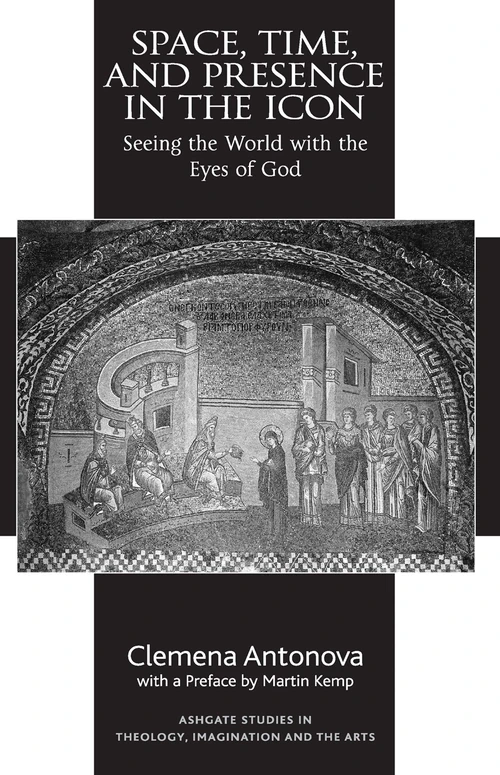
Space, Time, and Presence in the Icon
Seeing the World with the Eyes of God
- Publisher: Routledge
- Published: 2021
FritzSearch.com earns a commission on purchases made through Bookshop.org links.
Publisher's Description
This book contributes to the re-emerging field of 'theology through the arts' by proposing a way of approaching one of the most challenging theological concepts - divine timelessness - through the principle of construction of space in the icon. One of the main objectives of this book is to discuss critically the implications of 'reverse perspective', which is especially characteristic of Byzantine and Byzantining art. Drawing on the work of Pavel Florensky, one of the foremost Russian religious philosophers at the beginning of the 20th century, Antonova shows that Florensky's concept of 'supplementary planes' can be used productively within a new approach to the question. Antonova works up new criteria for the understanding of how space and time can be handled in a way that does not reverse standard linear perspective (as conventionally claimed) but acts in its own way to create eternalised images which are not involved with perspective at all. Arguing that the structure of the icon is determined by a conception of God who exits in past, present, and future, simultaneously, Antonova develops an iconography of images done in the Byzantine style both in the East and in the West which is truer to their own cultural context than is generally provided for by western interpretations. This book draws upon philosophy, theology and liturgy to see how relatively abstract notions of a deity beyond time and space enter images made by painters.
Endorsements (2)
“Antonova's analysis of "reverse perspective" in icons goes far beyond the portrayal of space. It goes to the very heart of the matter of how icons have worked for their users over the centuries.”
“Dr Antonova’s book devises a way of reading the temporal iconography of Eastern Orthodox images which is truer to their own cultural context than is generally provided for by western interpretations. This is an exciting and highly original book which builds enormously useful intellectual bridges. At a time when there is considerable interest in theories of pictorial representation , this is a major and potentially very influential cross-cultural work. It will certainly be a major contribution to understanding the relation between time and the pictorial image.”
See something wrong on this page? Report a problem