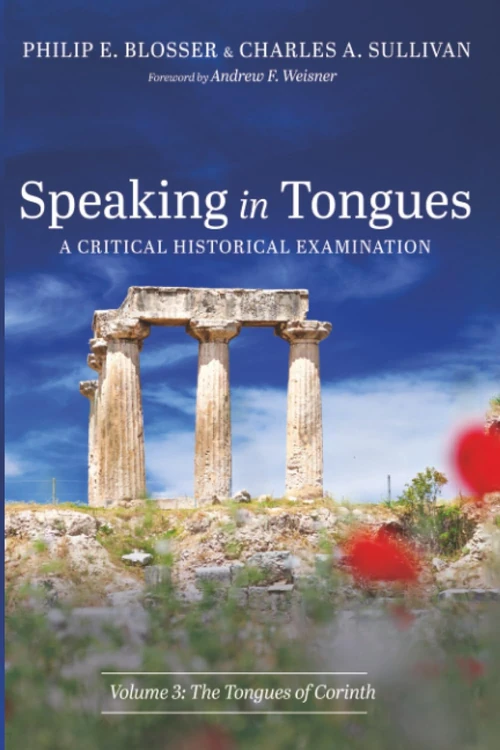
Speaking in Tongues: A Critical Historical Examination, Volume 3
The Tongues of Corinth
- Biblical Studies & Commentaries
- Publisher: Pickwick Publications (Wipf and Stock)
- Published: 2026
FritzSearch.com earns a commission on purchases made through Bookshop.org links.
Publisher's Description
The Christian rite of tongues, especially the one practiced in the ancient city of Corinth, is shrouded in mystery and is a perpetual source of controversy, debates, and new solutions. This third volume of Speaking in Tongues: A Critical Historical Examination delves deeply into the rite practiced in Corinth, Alexandria, Rome, and beyond. It is an exploration that traverses through classical, Talmudic, Byzantine, medieval, Reformation, and modern sources to build a comprehensive portrait of the Corinthian assembly, its worship, and its problems. The results demonstrate that St. Paul was addressing liturgical problems between opposing groups with different languages and customs. This explanation is equal to or better than the theories of mystical utterances or glossolalia because of its rich documentation. This book is a valuable resource for scholars, academics, and the intellectually curious who appreciate a higher level of detail. The historical information is sure to prompt the reader to reconsider what tongues and interpreters meant to the earliest participants of the Corinthian assembly.
Endorsements (4)
“In this magisterial, biblical, and historical treatment of the meaning of speaking in ‘tongues,’ Blosser and Sullivan muster significant evidence pointing toward the conclusion that the tongues are foreign languages, not unintelligible vocalization. The pastoral implications of their conclusions are large indeed, since they challenge a central pillar of the Protestant and Catholic charismatic movement, even if the fruitfulness of the movement arguably does not depend upon glossolalia. It is now up to charismatic Christians to respond or recalibrate.”
“Blosser and Sullivan’s Speaking in Tongues series is poised to challenge established views within the Pentecostal and Charismatic movements . . . The implications of this series are far-reaching for core Pentecostal and Charismatic doctrines, particularly the relationship between speaking in tongues and the baptism of the Holy Spirit . . . Their thorough historical analysis provides a compelling case for reevaluating the nature of speaking in tongues . . .”
“Pentecostals and charismatic scholars should welcome the challenge that Blosser and Sullivan bring. . . . If the notion of tongues as glossolalia or some form of ecstatic utterance is indeed an invention of nineteenth-century higher-critical thought that then filtered down to the popular level where early Pentecostals adopted it, then Pentecostals should admit the novelty of such a theory.”
See something wrong on this page? Report a problem