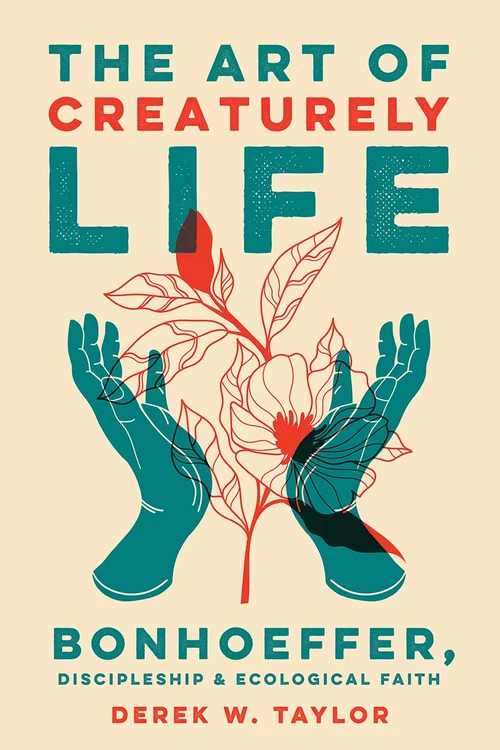
The Art of Creaturely Life
Bonhoeffer, Discipleship, and Ecological Faith
- Theology
- Ethics, Culture & Social Issues
- Publisher: Fortress Press (Augsburg Fortress)
- Published: 2026
FritzSearch.com earns a commission on purchases made through Bookshop.org links.
Publisher's Description
"How will the coming generations go on living?" This haunting question, posed by Dietrich Bonhoeffer during the darkest days of World War II, takes on fresh urgency in our age of climate crisis. Today, under its long shadow, we find ourselves gripped by the same uncertainty Bonhoeffer knew well. In The Art of Creaturely Life, Derek W. Taylor shows how Bonhoeffer's theology, forged within his context of crisis, offers resources for navigating our own. At its heart lies a vision of God's creative and redemptive grace. The future rests in God's hands. Rather than leading to apathy or defeatism, this realization opens new avenues of human responsibility. If God is the Creator, we are freed to be mere creatures. Jesus of Nazareth leads the way. In his life of authentic human creatureliness, creation itself is healed. To follow him is to step into new creation. Discipleship therefore calls us to turn from destructive, god-like ambitions and instead embrace the dependence, humility, limitedness, attentiveness, delight, and hope that mark our creaturely form. In walking the path of Jesus, we relearn the art of creaturely life. What emerges is a work of resistance--not against ecological degradation itself, but against the distorted vision of humanity that drives it. By placing Bonhoeffer in dialogue with other disciplines--from ecotheology and agrarianism to existential philosophy and postcolonial studies--this book cultivates the theological imagination needed to sustain a life of creaturely resistance in a time when creation's groaning seems louder than ever.
Endorsements (4)
“Derek Taylor has written a thoughtful and timely book that cuts through the noise of ecological despair to ask the right question: not "How do we fix this?" but "How do we become human again?" His use of Bonhoeffer to reimagine creaturely life is both theologically rich and practically urgent--and his engagement with Indigenous perspectives on place points toward exactly the kind of wisdom Western theology needs most right now.”
“If fear of ecological collapse threatens to induce paralysis or despair, Derek Taylor's wonderful book offers a christological antidote. These Bonhoeffer-inspired meditations remind us that we learn how to be creatures by looking to Jesus. Through a rare combination of prophetic urgency and pastoral encouragement, Taylor shows how fixing our eyes on Christ enables us to enact our hope without putting our hope in activism.”
“"If God is the sovereign creator and redeemer, then we are free to be mere creatures." With this wonderfully resonant sentence, Derek Taylor both summarizes and invites readers into a rich and unexpected theological journey. I confess I had given up on Christian theologians having anything interesting to say about ecology besides "whatever the agrarians and activists and doomers are saying--plus Jesus." Taylor turns my pessimism on its head by learning from Bonhoeffer to start with Jesus, the man from Nazareth, and to see what the new creation Jesus inaugurates has to say about our current situation. It turns out there is much to be said, and thus much to be heard. Start listening by reading this excellent book.”
“During a time of profound uncertainty, writes Derek Taylor, Dietrich Bonhoeffer "refused to abandon the future." The Art of Creaturely Life faces our own moment of ecological uncertainty and, drawing from Bonhoeffer's work and witness, invites us to refuse both the apocalyptic despair and the technological optimism that characterize our times. In their place, Taylor imagines a thoroughly different vision--lives adapted to the nourishing confines of our creatureliness.”
See something wrong on this page? Report a problem