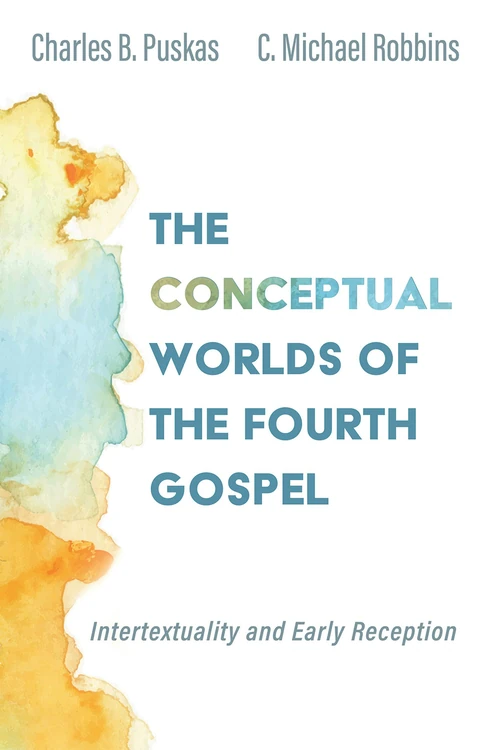
The Conceptual Worlds of the Fourth Gospel
Intertextuality and Early Reception
- Biblical Studies & Commentaries
- Publisher: Cascade Books (Wipf and Stock)
- Published: 2021
FritzSearch.com earns a commission on purchases made through Bookshop.org links.
Publisher's Description
Over, under, and through John's story of Jesus are unforgettable ideas and concepts, profoundly simple and simply profound, for the author's own audience and beyond. These ideas did not originate in a vacuum. They have recurred and been repeated before and after the writing of the Fourth Gospel. For this reason we will examine the meaning of its words and themes in the context of its Jewish-Greco-Roman milieu. Much of our intertextual understanding will be derived from alleged parallels that involve comparisons of similar vocabulary and phrases, as well as parallel concepts and images from the Old Testament, the Dead Sea Scrolls, Philo, and other relevant writings. Such parallels will help to determine the meaning of a word or expression, the translation of a particular language, determining any direct influences upon the Fourth Gospel, parallel traditions, or the influence of its ideas, as a creative and inspiring work of later antiquity.
Endorsements (4)
“The book fills a lacuna in Johannine scholarship. While interpreters often one-sidedly follow a certain contextualization, Jewish or Greco-Roman, the authors present the whole set of possible backgrounds, many of which are not mutually exclusive. The sober discussion helps to go beyond former limitations and to arrive at a synthetic understanding of John’s various reading contexts.”
“The Fourth Gospel, with compelling drama, complex imagery, scriptural citations and allusions, and engagement with serious conceptual issues, invites comparison with ancient literary sources, both Jewish and Greek. Puskas and Robbins offer a well-organized review of comparative material that may illuminate the Gospel. Well-documented and offering a probing critical framework, Conceptual Worlds offers an extremely useful tool for students of John both new and old.”
“As an advance over narrow, monodisciplinary approaches to the Fourth Gospel, this multidisciplinary analysis of the conceptual backgrounds and foregrounds of the Fourth Gospel by Charles Puskas and Michael Robbins offers a much-needed way forward. In displaying multiple parallels between Jewish and Hellenistic writings and the Gospel of John, today’s readers are well equipped to appreciate more fully how John’s original audiences would have perceived and experienced its message. Here, John’s interfluential dialogical autonomy is clearly displayed. As an autonomous memory of Jesus and his ministry, John’s dialogues with other gospel traditions, the Septuagint and other Jewish writings, and even Hellenistic religions and literature are laid out chapter after chapter, illuminating its rhetorical thrust and message for readers in front of the text both then and now. A must-read for historical, theological, and literary readings of the Fourth Gospel today.”
“While the Fourth Gospel provides a unique portrait of Jesus and his ministry, its ideas and vocabulary did not develop in a vacuum. Rather, the milieu in which the Gospel developed is rich and complex. Puskas and Robbins have generated a substantive and compelling volume that explores the Gospel in light of its potential influences and conversation partners in the ancient world. This text will prove useful for advanced courses on the Fourth Gospel.”
See something wrong on this page? Report a problem