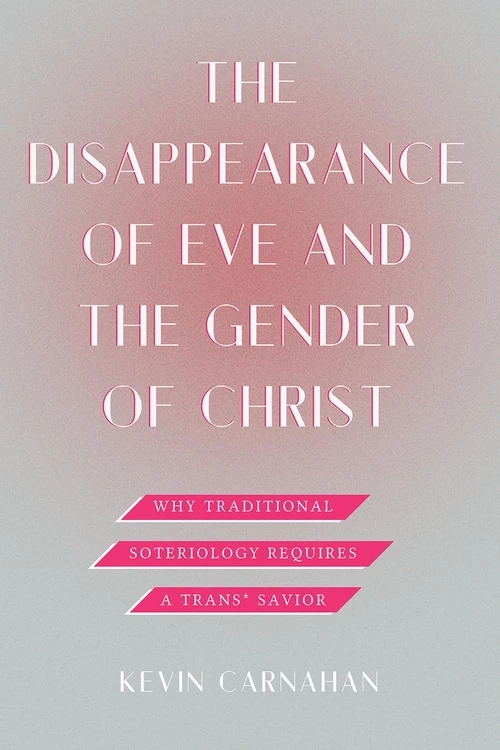
The Disappearance of Eve and the Gender of Christ
Why Traditional Soteriology Requires a Trans* Savior
- Theology
- Publisher: Fortress Press (Augsburg Fortress)
- Published: 2025
FritzSearch.com earns a commission on purchases made through Bookshop.org links.
Publisher's Description
After hundreds of years during which Eve was blamed for originating sin, St. Paul removed her from the narrative of the fall to create a "one man"/"one man" typology between Adam as the origin of sin and Christ as the source of salvation. This disappearance created a theological problem. Eve fell outside the narrative of sin and salvation. Early Christians, sensing the lack in Paul's formula, created an alternative typology between Eve, the mother of all the living, and Mary, the mother of Jesus. Eventually, early theologians attempted to solve the soteriological problem Eve posed by coordinating these two typologies. This solution, however, produced a furthur dilemma. Either Mary had to be posited as a second savior, or the salvation offered to Eve in the revised scheme had to be second-class. Neither option is theologically acceptable. The Disappearance of Eve and the Gender of Christ proposes a solution to this problem. It revises Paul's original formula and with it a set of common claims about Christ's sex and gender. It accepts Christ as the new Adam and the new Eve and accepts that Christ is, theologically speaking, trans*. Carnahan offers a new theology of sex and gender as a calling within a context of responsibility as a framework for making sense of Eve, Christ, and ourselves. He shows how, from first-century Roman culture to medieval mystical experience and into our own time, there exists a long tradition of seeing Christ as transgressing and even transitioning across sex and gender boundaries.
Endorsements (3)
“Praise for The Disappearance of Eve and the Gender of Christ Carnahan’s book fills a significant void in scholarship on theology and trans* identity. He engages a breadth of sources, including scriptural and patristic sources and gender theory, to join theologians past and present in searching for the universal accessibility of transformation through Christ. Carnahan addresses the soteriological problem by recognizing that sex and gender, while not the highest good, are intertwined with our identities and are part of the callings to which we respond. Ultimately, he makes the bold, inclusive claim that Christ incarnates gendered/sexed diversity, opening salvation to all who accept Christ. Carnahan’s naming of Christ as trans* beautifully embraces the deep, abiding mystery of Christ bringing salvation to all of humanity. His book challenges theologians to pursue “the creative opportunities” of dialogue rooted in tradition.”
“Carnahan offers a bold, brave, original, and provocative argument that Christ must be trans to save all genders. More widely, this is one of the best discussions I have seen of sex and gender as calling and responsibility—embodied, social, dynamic, yet not entirely open-ended. Agree or disagree, the reader will learn much from this engaging testament.”
“trans theologies.”
See something wrong on this page? Report a problem