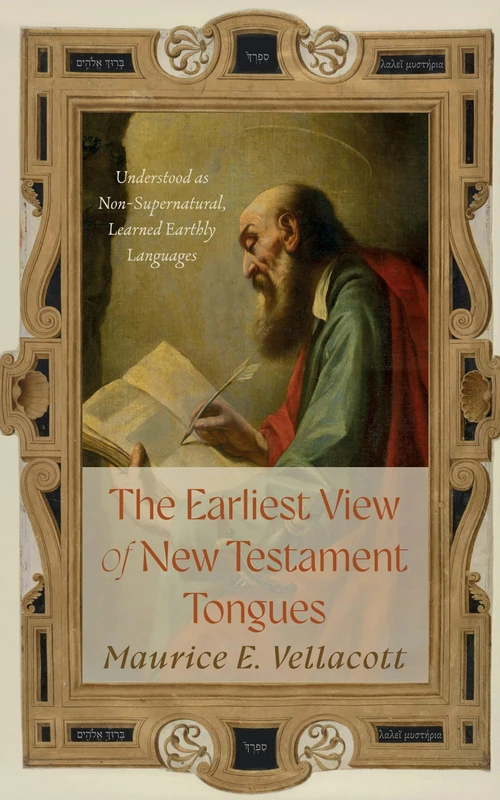
The Earliest View of New Testament Tongues
Understood as Non-Supernatural, Learned Earthly Languages
- Biblical Studies & Commentaries
- Publisher: Resource Publications (Wipf and Stock)
- Published: 2024
FritzSearch.com earns a commission on purchases made through Bookshop.org links.
Publisher's Description
This book is a groundbreaking, paradigm-shifting look at the "languages/tongues" problem (γλῶσσαι/glṓssai) of the first-century AD Corinthian church. It adduces that in a multilingual setting, new converts were expressing themselves in their native dialect without translation, where Koine Greek was not yet overriding all regional dialects. This cuts against the idea that the inferred earthly languages were miraculously and instantaneously given--an idea not found before 160 AD. Vellacott's comprehensive linguistic, cultural, historical, contextual, exegetical and translational research also weighs against the view that "tongues" were "heavenly languages," as claimed by Pentecostals/Charismatics. Primary sources indicate that this novel trend was started about 145 years ago by German, higher-critical scholars and seized upon after the 1906-15 Los Angeles Azusa Street Revival's supposed supernaturally endowed earthly languages proved to be a mirage, whereupon a redefinition to "heavenly/angelic, non-earthly languages" occurred. This book soundly establishes the credibility of an ancient third view regarding "tongues"--that they were non-supernatural, learned, earthly languages. This is arguably the earliest view of New Testament tongues/languages.
Endorsements (2)
“Vellacott interacts with a wide range of scholars on the topic, arguing for a non-mainstream interpretation of tongues. He largely relies on the writings of the church father Epiphanius who understood tongues to refer to natural earthly languages. He then uses the Epiphanius perception of tongues as key to interpret references to tongues in the New Testament. Vellacott advances compelling arguments for the acceptance of Epiphanius’s interpretation that are worthy of consideration. His interpretation deserves to be accounted for in scholarship. The work is written in an accessible and engaging way. Since the topic of speaking in tongues is debated beyond academia, this book should appeal to a wider audience.”
“The sources cited for the book are extensive and impressive. The sources used are critically engaged in an integrated manner, and Dr. Vellacott interprets the sources used in a balanced manner. Where applicable, the salient aspects of arguments from scholars are authentically represented. The book contains an overall logical argument, and the different chapters form a cohesive whole. There is a consistency in the thesis. The study is systematic, logical, well-structured, balanced and clear. The book contains a high quality of research. The work is written in an accessible and engaging way, and because of the topic, it should appeal to a wider audience. The quality of the writing is of a high standard.”
See something wrong on this page? Report a problem