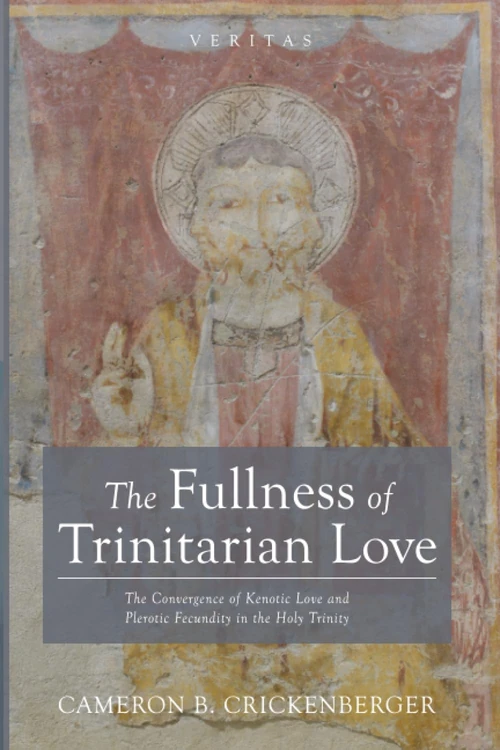
The Fullness of Trinitarian Love
The Convergence of Kenotic Love and Plerotic Fecundity in the Holy Trinity
- Theology
- Publisher: Cascade Books (Wipf and Stock)
- Published: 2026
FritzSearch.com earns a commission on purchases made through Bookshop.org links.
Publisher's Description
Though rooted in a well-known New Testament passage, the identification of God with love has proved to be a contentious issue for theologians throughout the history of Christian theology. This is due to the various ways that love can be understood within creation and the difficulty of attributing much of this to the divine nature. In this new publication of his doctoral dissertation, Cameron B. Crickenberger marshals the insights of theologians including Thomas Aquinas, Hans Urs von Balthasar, Ferdinand Ulrich, and Klaus Hemmerle to develop a constructive way of integrating the various aspects of love that often conflict with each other when attributed to the trinitarian God. Interrelationality with God, the paradox of Unity and Plurality, the nature and role of kenotic love in the divine life, and the profound and underappreciated importance of final causality in our theological language, this volume attempts to advance the protracted theological conversations between various camps in order to open new avenues of theological reflection on the Holy Trinity.
Endorsements (2)
“In this book, Cameron Crickenberger sheds new light on an ancient theological mystery: the triune God who not only loves, but who essentially is love. He is able to do so because he can engage dialogue—at an astonishingly profound level—between Aquinas and lesser-known sources, including Ferdinand Ulrich, whose work is just beginning to receive the study it warrants.”
“In the company of Thomas Aquinas and Hans Urs von Balthasar, Cameron Crickenberger takes us into the mystery of the confession that God is love. He offers an analogia amoris—a profound meditation on creation as a participation in the eternal love of the Trinity. This is a work of creative synthesis, metaphysical insight, and theological imagination that shows again why love alone is credible.”
See something wrong on this page? Report a problem