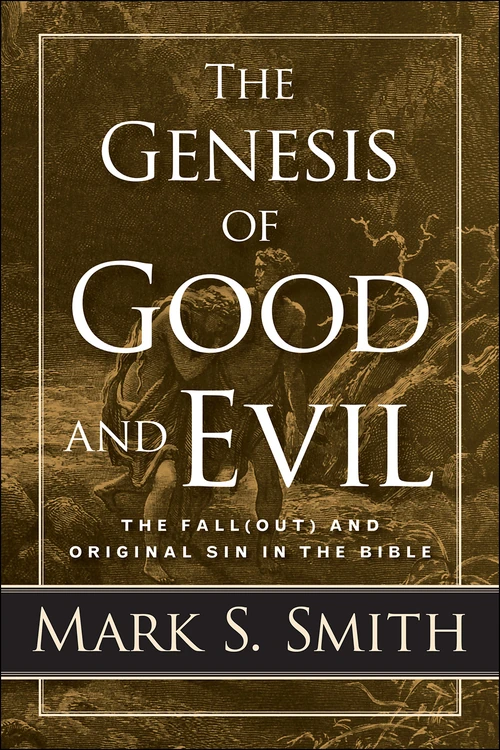
The Genesis of Good and Evil
The Fall(out) and Original Sin in the Bible
- Biblical Studies & Commentaries
- Publisher: Westminster John Knox
- Published: 2019
FritzSearch.com earns a commission on purchases made through Bookshop.org links.
Publisher's Description
For centuries, the Garden of Eden story has been a cornerstone for the Christian doctrine of “the Fall” and “original sin.” In recent years, many scholars have disputed this understanding of Genesis 3 because it has no words for sin, transgression, disobedience, or punishment. Instead, it is about how the human condition came about. Yet the picture is not so simple. The Genesis of Good and Evil examines how the idea of “the Fall” developed in Jewish tradition on the eve of Christianity. In the end, the Garden of Eden is a rich study of humans in relation to God that leaves open many questions. One such question is, Does Genesis 3, 4, and 6, taken together, support the Christian doctrine of original sin? Smith’s well-informed, close reading of these chapters concludes that it does. In this book, he addresses the many mysterious matters of the Garden story and invites readers to explore questions of their own.
Endorsements (6)
“Smith cuts through the miasma of the history of interpretation of Genesis 3 and ‘the Fall’ with his characteristically incisive clarity. As readers hear this classic text speak afresh, they will rethink their deepest assumptions about the human condition and God’s will for us.”
“With a welcoming voice and his characteristic erudition, Mark Smith takes on some of the most profound questions in Western religions. As he readily acknowledges, this book raises more questions than it answers; it could not be otherwise. But for those interested in further explorations, it also offers a wealth of resources.”
“Was there a ‘Fall’? Was there an ‘original sin’? The prolific author Mark Smith offers insight and writes with clarity and profundity on these pivotal topics that are so vital to biblical theology. While not all will agree with every element of his analysis of the relevant texts, his reflections will provoke better understanding and further discussion. All those who are interested in these important questions will have to reckon with Smith’s perspective.”
“Smith has written a valuable book, providing detailed analysis of biblical (especially Genesis 3–4; 6) and relevant ancient Near Eastern literature, an exploration of broad theological issues such as the nature of humanity in Genesis and ‘the mystery of God,’ and an overview of the ways ‘original sin’ has been understood by Christian theologians. Smith concludes that it is better to speak of the ‘fallout’ of what happens in Genesis 3 rather than the ‘Fall.’ This is a volume that will prove useful to the general reader and the specialist alike.”
“Mark S. Smith draws from knowledge and insights in the works of ancient and premodern theologians and biblical commentators typically found on traditional Christian and Jewish bookshelves as well as from research found on the bookshelves of twenty-first-century historians and language experts, all specialists in different aspects of ancient Israel’s culture and the contemporaneous civilizations of the pre-Christian, ancient Near East. Smith, a highly regarded expert in the field, answers old theological questions for himself and for a new generation of questioners. The book reads quickly. It is an action adventure for the restless mind that has a satisfactory but open-ended conclusion. For those interested in how Smith pulls this off, he provides a large section of endnotes containing references and sidebar discussions.”
“Mark Smith’s latest book is an effort ‘to come to grips with Christian claims about the Fall and original sin in Genesis 3.’ He then sets off, in his inimitable way, to explore seven questions that lead him not only back to Genesis 2, and then forward to Genesis 4 and 6, but also beyond: to Augustine, Calvin, the Catholic Catechism, and seemingly every pertinent nook and cranny in the ancient Near East. Spoiler alert: Smith disagrees with a large swath of Christian tradition, finding not a fall in Genesis 3 but a fallout that comes about thereafter, though also remarkable possibilities for human goodness despite our ‘Adam-ness’ and ‘Eve-ness.’ Smith’s goal is to find out what Genesis 3 ‘really says’—which is a hackneyed and usually dubious claim, but not in the case of Smith, whose erudition will educate even the most serious scholar while his fluid prose remains intended for ‘anyone intrigued by what happened in the Garden of Eden.’ Smith ends his study in praise of theological mystery and human curiosity; there is equally also a great deal to praise in this book and in Smith’s work among us.”
See something wrong on this page? Report a problem