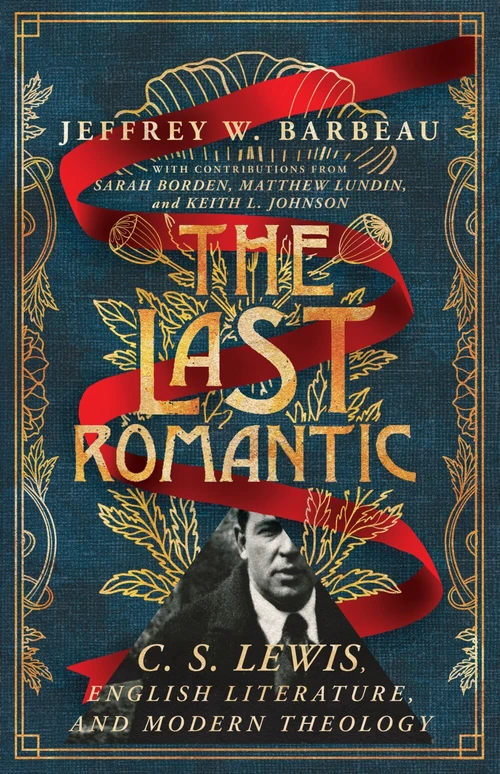
The Last Romantic
C. S. Lewis, English Literature, and Modern Theology
- Arts & Literature
- Publisher: IVP Academic (InterVarsity Press)
- Published: 2025
FritzSearch.com earns a commission on purchases made through Bookshop.org links.
Publisher's Description
Credo Book Award Winner – Natural Theology "There are so many books on Lewis that are simply a rehash of existing knowledge; by contrast, this is a work of fresh, detailed, illuminating scholarship.... Barbeau's use of Lewis's personal annotations in the books in the Marion E. Wade Collection is a revelation and makes this book a permanent and important contribution to the study of Lewis's thought." – Malcolm Guite, Girton College, Cambridge Three Essays on C. S. Lewis and Romanticism Many readers have heard C. S. Lewis's logical arguments for the Christian faith. Yet throughout his wide-ranging study and writing, Lewis often began with experience, intuition, and religious feeling rather than dogmatic assertions. The most profound questions of Lewis's own life, argues theologian and literary critic Jeffrey Barbeau, can be seen in his quest to understand the relationship between personal experience and the truth about the world around him. In a series of three essays, Barbeau explores the influence of nineteenth-century Romanticism on the writings of C. S. Lewis. Barbeau demonstrates Lewis's indebtedness to Romantic notions of imagination and subjectivity, opens new contexts for understanding ideas about memory and personal identity in his autobiographical writings, and explores beliefs about nature and Christian sacraments throughout his writings on Christian faith. This theological and literary investigation reveals Lewis as a profoundly modern thinker and illuminates his ongoing relevance to contemporary debates about theology and culture. Drawing on extensive reading of the marginalia in the personal library of C. S. Lewis held by the Marion E. Wade Center, Barbeau offers a fresh understanding of the influence of modern theology and Romantic poetry, especially Wordsworth and Coleridge, on many of Lewis's most beloved works. Essays and responses include: C. S. Lewis and the "Romantic Heresy," with response from professor Sarah Borden, C. S. Lewis and the Anxiety of Memory, with response from professor Matthew Lundin, and C. S. Lewis and the Sacramental Imagination, with response from professor Keith L. Johnson. About the Series The Hansen Series celebrates the literary and spiritual contributions of seven British authors whose works have captivated readers across generations: Owen Barfield, G. K. Chesterton, C. S. Lewis, George MacDonald, Dorothy L. Sayers, J. R. R. Tolkien, and Charles Williams. These seven authors were all deeply involved in the friendships and intellectual exchanges that shaped the Inklings, a mid-twentieth-century group of Christian writers and thinkers in Oxford, England. This series invites readers to deepen their engagement with these timeless voices and their enduring influence on literature, faith, and the life of the imagination.
Endorsements (5)
“As a scholar, Professor Barbeau does not disappoint. He has done remarkable research teasing out the degree to which C. S. Lewis was affected by the English Romantics, which he says was pervasive and primary. His style is winsome and engaging. Did he make the case? Let the reader decide. I must say, I enjoyed the book and discovered some things I had not seen before. It is a good read!”
“There are so many books on Lewis that are simply a rehash of existing knowledge; by contrast, this is a work of fresh, detailed, illuminating scholarship. Barbeau's work on Lewis's long, close, and intimate reading of Coleridge and Wordsworth has unveiled new depths and even given us a newly discovered poem by Lewis. Barbeau dismantles the clichéd idea that the Romantic element is mere subjectivity and shows decisively how Lewis's 'Romantic' engagement with intense personal experience actually dovetails with and reinforces his arguments for the objective truth of Christianity. Barbeau's use of Lewis's personal annotations in the books in the Marion E. Wade Collection is a revelation and makes this book a permanent and important contribution to the study of Lewis's thought.”
“Jeffrey W. Barbeau's eloquent and accessible lectures look past the blinding assumptions of standard intellectual history to discover a modern C. S. Lewis inspired by religious Romanticism—a vital, creative tradition of poetry and thought that unites the subjective and objective, the personal and the divine. Lewis's place in this visionary company was there all along, expressed in his stories, essays, self-representations, and previously unpublished marginalia. Thanks to Barbeau, we may also see that Lewis, like Elijah on Horeb, was not alone as the last inspiring, faithful Romantic.”
“This beautifully crafted book sets the religious writings of Lewis within the context of German idealism and English Romanticism. Barbeau brilliantly draws upon the marginalia in books from Lewis's own library to place him within the tradition of Methodism, the poetry of Wordsworth and Coleridge, and the philosophy of Schleiermacher, Hegel, and Feuerbach. In the construction of theological language, Lewis is revealed afresh as a deeply learned, sensitive, and serious Christian thinker.”
“The Last Romantic—a bold claim about Lewis, yet one that Barbeau fully supports with fascinating detail—offers not only the best guide to Lewis's engagement with the Romantics, it is also a wonderful study of Lewis's thought and faith in general, as well as a wise meditation on connections between modern theology and the Romantic imagination. Enter this wardrobe and you will not come out the same.”
See something wrong on this page? Report a problem