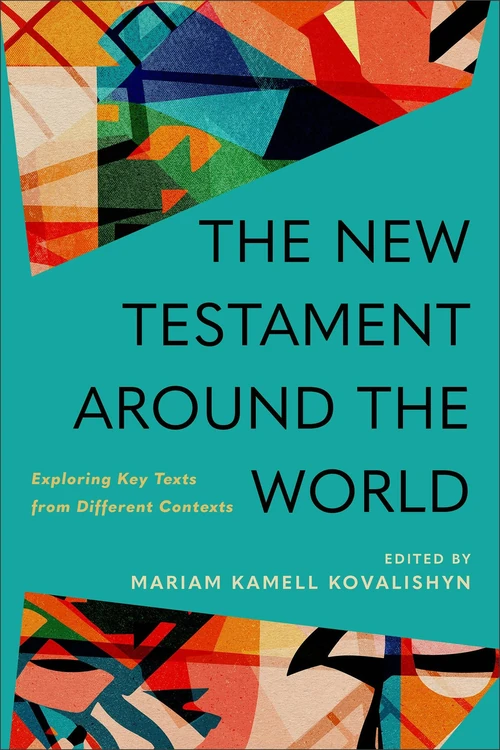
The New Testament around the World
- Biblical Studies & Commentaries
- Publisher: Baker Academic (Baker Publishing Group)
- Published: 2025
FritzSearch.com earns a commission on purchases made through Bookshop.org links.
Publisher's Description
As the church continues to expand and strengthen in non-Western contexts, it is increasingly important for students of the New Testament to be aware of how our global brothers and sisters exegete and apply Scripture. Even when we share a grammatical-historical approach with others, our interpretation of biblical texts is invariably affected by social location and cultural context, which influence the questions we ask of the text and how we apply it. Western readers can become aware of how our culture influences our interpretation by learning from others from different perspectives, including those whose experience may match the original audience more closely than our own. This volume, ideal as a supplemental textbook for courses in the New Testament, brings together distinguished scholars from around the world with perspectives we might not typically encounter and includes some minority voices focused on life within the United States as well. Each contributor writes on a biblical book or group of books, and together they cover the whole New Testament. These authors expose students and pastors in the West to new questions and ways of reading familiar texts. The result is an eye-opening, spiritually enriching experience that will supplement and strengthen our own biblical interpretation.
Endorsements (6)
“This is a book I’ve been waiting for. In it, we listen to and learn from scholars across the majority world. Each author offers a close reading of a New Testament text in its context, alongside an exploration of their own cultural and social locations. The insights arising from this intersection are both fresh and compelling. I highly recommend this as a textbook for courses on the Bible.”
“Kovalishyn takes us around the world in twenty-two chapters by twenty-two Bible interpreters. This work demonstrates how one’s cultural and geographical location affects interpretation. Familiar texts are discussed from unfamiliar perspectives, yielding new insights and deeper understandings for Western readers. These samples of ‘situated exegesis’ will be of interest to a broad audience, from pastors to students to scholars of hermeneutics. Highly recommended.”
“None of us reads the Bible neutrally. Whether we recognize it or not, we read and interpret the Bible from our own culture, experiences, and personal perspective. That is a bad thing if we assume we know everything but a good thing if we are willing to read Scripture with others and learn from each other’s vantage points. These global readings are a gift of learning for those who want to better understand culturally diverse interpretations of the New Testament.”
“The excellent scholarly essays in this important book, covering aspects of the New Testament from Matthew to Revelation, demonstrate the significance of contextual scriptural interpretation. Each chapter makes an important contribution, and the book as a whole is part of a seismic shift in the field of New Testament studies. I hope this volume is widely read by scholars and students alike.”
“I wish I were still teaching full-time so that I could use this as my main supplemental textbook in my New Testament introduction and survey courses. Many works have tried to show how crucial it is to read the Bible through the eyes of other cultures, nationalities, and ethnicities besides white American ones, but few have succeeded as well as Mariam Kovalishyn and her cadre of authors. Highly recommended!”
“This book truly is just as much a reformation as it is a revolution. It is not just new; in many ways it is a return to original hermeneutics. Modernist, white, Western ways of interpreting Scripture, which have held sway for much of church history, are not the only, or even the primary, ways of understanding the Bible. Our brothers and sisters from around the world provide cultural lenses that are much more similar to those of first-century readers. This is not a relativistic reading of the Bible; it is a more authentic one. This is an invaluable polycentric resource that forms a bridge between the ancient world and our modern global one.”
See something wrong on this page? Report a problem