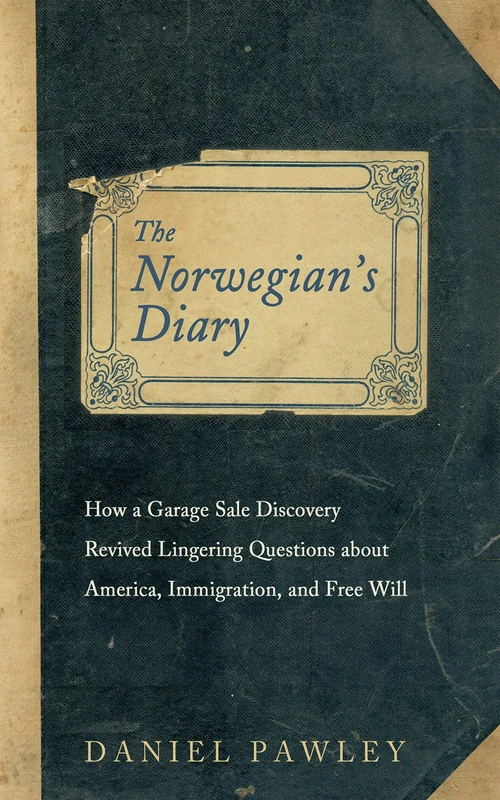
The Norwegian’s Diary
How a Garage Sale Discovery Revived Lingering Questions about America, Immigration, and Free Will
- History & Biography
- Publisher: Resource Publications (Wipf and Stock)
- Published: 2024
FritzSearch.com earns a commission on purchases made through Bookshop.org links.
Publisher's Description
In the closing days of the 20th century, author Daniel Pawley discovered a Norwegian-American immigrant's diary from a century earlier while browsing for old books at a Minnesota garage sale. With fascination, he read the diary from cover to cover, turned the experience into a prize-winning magazine article, and then filed it away in memory. More than two decades later, however, as an immigrant himself, from America to Portugal, he rediscovered the diary and his original notes, marveling at topics and themes all immigrants have in common. Both the excitement and insecurity of transitioning to a new culture and way of life stood out to him, even though the original diary told the story of a man whose life was characterized by far greater problems experienced by immigrants to America in earlier times. The daily torture of pre-labor-union industrial life, as well as the tragedies of family rearing amid poor economic conditions, stand out in this regard, raising questions about America's past, present, and perhaps future, too. This is a story worth revisiting by all who have interests in America or immigration and by anyone who has felt trapped by circumstances but energized by life-changing journeys of hope and promise.
Endorsements (5)
“This book’s research and presentation are amazing. And to link it all to one man’s diary makes it a fascinating read. The history of the immigrant population in America and the country’s very poor handling of underclass immigrants raises essential issues about the drive for success with little concern for the underprivileged. It’s a timeless story of continuing relevance to immigrant challenges in our own day.”
“A thought-provoking book sprinkled throughout with in-depth, vivid details about the innermost thoughts of an immigrant. Daniel Pawley’s command of language and phrasing is greatly appreciated in applying relatable insights into an otherwise academic subject. I found myself going back, re-reading, and thinking about my own experiences as an immigrant. This is a book to read and read again.”
“The author draws attention to the experience of immigrants in America and the hardships of their lives. He reflects on what it meant—and means—to leave a familiar world behind and set out for an unknown land. Contemplative and discursive, this book, in drawing on the life of one quiet-living man, ponders the question of human destiny. In the end, though, is silence, the silence of God. Daniel Pawley has a novel take on his subject in that he himself is an immigrant, as extracts from his own diary illustrate, in the book’s epilogue.”
“The epilogue was my favorite part as the author responds to the Norwegian’s diary of a hundred years ago with sections of his own personal diary. But really the entire book, which weaves threads of immigrant stories involving struggle, home, racial issues, church life, and the ‘American Dream,’ have helped me think about my own immigrant journey across three cultures toward eventually becoming an American citizen. There is much to savor here about leaving and finding home as seen through the eyes of an immigrant from a century ago.”
“This is a fascinating look at the historical and cultural contexts of the late nineteenth and early twentieth centuries in America, especially if your Norwegian ancestors arrived during that time, as mine did. Ollis’ story gives Daniel Pawley a framework to explore broader topics about America at that time, such as labor, religion, the media, racism, and philosophy, in addition to offering ‘lingering questions’ raised by the diary. An immigrant to Portugal since 2016, Pawley also turns the lens on himself, refocusing the historic narrative with a bridge to current-day immigration topics.”
See something wrong on this page? Report a problem