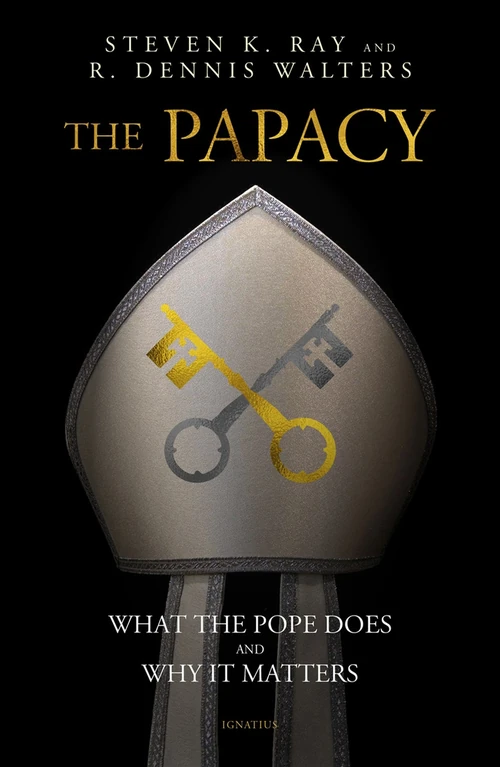
The Papacy
- Theology
- Publisher: Ignatius Press
- Published: 2018
FritzSearch.com earns a commission on purchases made through Bookshop.org links.
Publisher's Description
The Papacy explains that without the Pope's divinely guided leadership, the Church would suffer the contradictions and the divisions that many Christian groups know firsthand. The teaching passed down from the apostles would be subject to arbitrary, relative, and numerous interpretations; holiness would be only a distant ideal; and the one, holy, catholic, and apostolic Church founded by Jesus would break apart. In describing the Pope's important and singular role as leader and teacher, the book addresses common misconceptions and objections to the papacy. It also explains how the papacy developed and how the Pope is elected. The authors present some great Popes in history, showing the qualities and the accomplishments that made them great. They demonstrate that the Pope is important not only for Catholics, but also for non-Catholic Christians and even non-Christians.
Endorsements (4)
“This is a clearly written, easy-to-read explanation and defense of the papacy. I would recommend any Catholic, or even anyone interested in this much misunderstood part of the Catholic faith, to pick up a copy.”
“This book offers an easy-to-digest, clear introduction to all things papal. From Peter to Francis, from Matthew's Gospel to Revelation, and from the first century to the twenty-first, it shows why the papacy has an indispensable role in salvation history.”
“The authors deftly untangle knotty misconceptions and make the case that Christianity will thrive in the present age only if we recover the unity that Christ intended the Petrine ministry to protect and cultivate.”
“With their usual boundless enthusiasm, Steve Ray and Dennis Walters provide a fascinating and easy-to-read look at the papacy—one of the key aspects of Christ’s Church and one of the most crucial institutions in world history.”
See something wrong on this page? Report a problem