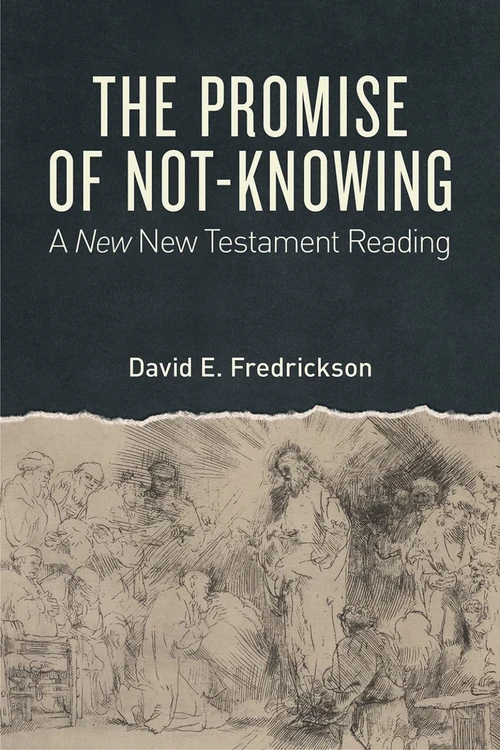
The Promise of Not-Knowing
A New New Testament Reading
- Biblical Studies & Commentaries
- Publisher: Fortress Press (Augsburg Fortress)
- Published: 2022
FritzSearch.com earns a commission on purchases made through Bookshop.org links.
Publisher's Description
David E. Fredrickson asks a key question for interpreters of the New Testament in the twenty-first century: Do established ways of reading the New Testament need to be challenged and new ones explored? His answer is "yes," but he takes care not to dismiss readers' experiences in the previous two millennia. He values the readings of the past even as he contests the insights of scholars, preachers, monks, nuns, skeptics, the devout, the disinterested, the keenly interested, and all the rest who have tried to make sense of the earliest Christian writings. Fredrickson does not want to give an impression of "I know better than them." But he goes on to say that "strange as it sounds, not-knowing is actually the point of this book. More than anything else, not-knowing is, I believe, the key to reading the New Testament in the twenty-first century." Fredrickson claims that the reduction of a text to its usefulness is something a deconstructive approach seeks to avoid. That leads to readings in which practicality enjoys a privilege over mystery, knowing wins out over not-knowing, and control triumphs over hope. Ultimately, his goal in this book is to give mystery, hope, andnot-knowing a chance. For Fredrickson the experience of reading is more than coming to know something or receiving information, and the "more" that he has in mind exists in the shock of encountering some other or something that is not easily assimilated to an already known world, a familiar horizon, or the repeatability of language. What if reading the New Testament meant giving an unexpected other a chance to take place and to change the world you thought was an unchangeable given? What if we thought of reading as a way of preparing for what postmodernism calls an event?
Endorsements (2)
“And what if the answer to our heritage of culture wars—which have so effectively colonized and policed the sacred—were to bracket our drive for victory, to open the chance for a new spirit, a new spirituality? And what if the New Testament itself were released from the old cultural inheritance to incite this new exodus from war, and this on the merest promise of spiritual renewal? Caution, reader: With this new New Testament reading in hand you may just find yourself bereft of weapons, without the identity forged by culture wars, and instead nothing but newly awake and alive in ways you just could not have known before. This book is a risky masterpiece.”
“David Fredrickson is calling Christians to rid themselves of certainty and cerebrality in reading the New Testament. His mastery of Greek and his knowledge of ancient Greek poets convince the reader that the New Testament should be read for its emotion, ‘madness,’ and passion. If twenty-first-century Christians can do this, they will not only discover a whole new world of divine hospitality but a whole new sense of the humanity and hopefulness of the New Testament.”
See something wrong on this page? Report a problem