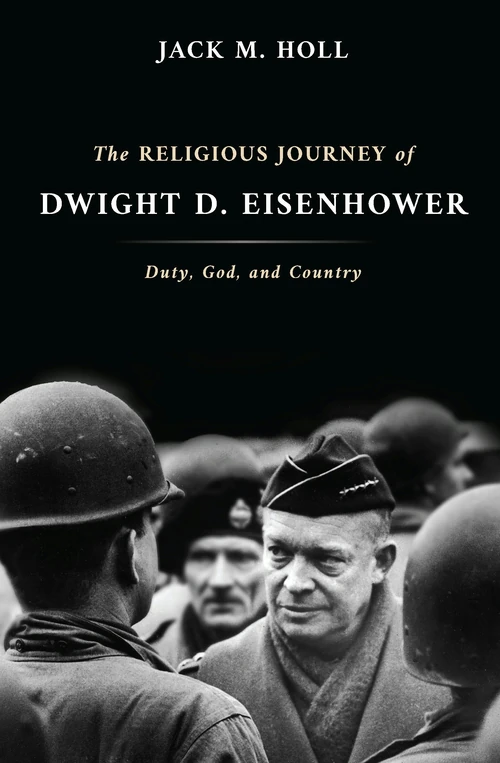
The Religious Journey of Dwight D. Eisenhower
Duty, God, and Country
- History & Biography
- Publisher: Eerdmans
- Published: 2024
FritzSearch.com earns a commission on purchases made through Bookshop.org links.
Publisher's Description
“Our form of government has no sense unless it is founded in a deeply felt religious faith, and I don’t care what it is. With us, of course, it is the Judeo-Christian concept, but it must be a religion that all men are created equal.” So said Dwight D. Eisenhower shortly after being elected president of the United States in 1952. Although this statement has been variously interpreted, it reflects one of his fundamental guiding principles: that for a country to thrive, it needs a shared identity, formed through common values, history, and purpose. For Eisenhower, this could be found most distinctly in shared faith—a concept that came to be known as American civil religion, which defined and drove much of the cohesion of the 1950s under Eisenhower’s leadership. This biography tells the story of how deeply religious convictions ran through every aspect of Eisenhower’s public life: his decision to become a soldier, his crusade against fascism and communism, his response to the civil rights movement, his belief that only he as president could lead America through the Cold War, and his search for nuclear peace. Having been brought up in a devout family—first as part of the River Brethren and later Jehovah’s Witnesses—Eisenhower continued to see the world in terms of a dialectical struggle between divine and demonic forces throughout his life, even after joining the Presbyterian church. This perspective shaped his public image as a general in World War II and as president during some of the coldest years of the Cold War, when cultural differences between the atheistic Soviet Union and the religiously grounded United States began crystallizing. As Eisenhower’s historical standing continues to rise, and his contrast with the modern Republican Party deepens, Jack Holl’s study of this consequential figure of twentieth-century American history shines a spotlight on what has changed in the intervening years. What can be learned from the religious outlook of a public servant who embraced moderation instead of partisan division? Which beliefs and convictions led a former general to a position of skepticism against the military-industrial complex? With the role of faith in American political life still a hotly debated topic today, Eisenhower’s religious journey is worth renewed attention.
Endorsements (6)
“Jack Holl has effectively refuted skeptics who easily assume that Dwight Eisenhower’s presidential statements on religion were politically motivated. Ike’s faith reflected ‘still waters running deep,’ informing all his actions and policies. Although not sectarian, Eisenhower believed that America’s civil religion, a legacy of the founding fathers, was essential to the preservation of American democracy. In Holl’s words, Eisenhower saw himself as ‘a civil pastor to all Americans who believed in God,’ and—critically for scholars of his racial policies—Ike envisioned ‘a spiritual America unconstrained by color or creed.’”
“It was no coincidence that Dwight D. Eisenhower oversaw a crusade in Europe against Nazism during World War II and a subsequent crusade against godless communism during the Cold War. The call of duty and allegiance to the Constitution forged during his military career confirmed his faith in God. His moral compass did not waver, shaping his actions as soldier, educator, and politician. Jack Holl’s new biography brilliantly fashions a thoughtful and sharp-eyed interpretation of Ike’s military and civilian contributions through the lens of his religious beliefs. The bold examination of Eisenhower’s religious journey and its legacy for American culture and politics offers a fresh perspective on religion, Eisenhower, and the United States in the twentieth century. Holl’s book is an incisive and important read.”
“In this engaging reinterpretation of a great American’s private experience and public career, Holl draws on a lifetime of learning to explore the centrality of Eisenhower’s religious journey to his rhetoric and policies as a Cold War president. As a result, Ike’s ‘middle way’ in politics resurfaces in a compelling new dimension. This is an indispensable addition to the Eisenhower literature.”
“This outstanding contribution to the Eisenhower bibliography provides a new approach to understanding Ike’s life and career that most historians have overlooked. Combining his history credentials with theology, the author establishes the nondenominational ‘civil religion’ that served Ike so well, providing us with a new understanding of Ike as a leader and as a man.”
“Taking the religious life of Dwight Eisenhower seriously, Jack Holl has masterfully uncovered not only a more dynamic personal faith than civil religion implies but a humbler one. The mark, Holl asserts, of Eisenhower’s religious journey, from Abilene to North Africa to Washington, was considered moderation. A mark, too, of this fine biography—a detailed, impressive account.”
“Much like the revisionist analysis of Eisenhower’s ‘hidden-hand’ leadership, The Religious Journey of Dwight D. Eisenhower reveals a largely unknown but important side to understanding the nation's thirty-fourth president. Professor Holl’s well-documented research makes a convincing case that religion had a profound impact on Eisenhower’s life, worldview, and executive decision-making. Highly recommended for scholars, students, and interested observers of the American presidency and of the intersection of religion and politics.”
See something wrong on this page? Report a problem