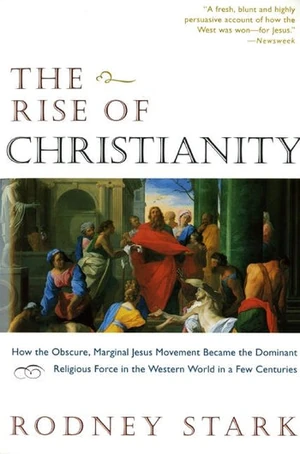
The Rise of Christianity
How the Obscure, Marginal Jesus Movement Became the Dominant Religious Force in the Western World in a Few Centuries
- History & Biography
- Publisher: HarperOne
- Published: 1997
FritzSearch.com earns a commission on purchases made through Bookshop.org links.
Publisher's Description
Rodney Stark's \"fresh, blunt, and highly persuasive account of how the West was won—for Jesus\" (Newsweek)—a provocative report that challenges conventional wisdom and finds that Christianity's astounding dominance of the Western world arose from its offer of a better, more secure way of life. \"Compelling reading\" (Library Journal) that is sure to \"generate spirited argument\" (Publishers Weekly), this account of Christianity's remarkable growth within the Roman Empire is the subject of much fanfare. \"Anyone who has puzzled over Christianity's rise to dominance... must read it.\" says Yale University's Wayne A. Meeks, for The Rise of Christianity makes a compelling case for startling conclusions. Combining his expertise in social science with historical evidence, and his insight into contemporary religion's appeal, Stark finds that early Christianity attracted the privileged rather than the poor, that most early converts were women or marginalized Jews—and ultimately \"that Christianity was a success because it proved those who joined it with a more appealing, more assuring, happier, and perhaps longer life\" (Andrew M. Greeley, University of Chicago).
Endorsements (3)
“Stark finds that Christians prospered the old-fashioned way: by providing a better, happier and more secure way of life . . . In the end, Stark concludes, Christians 'revitalized' the Roman Empire.”
“Anyone who has puzzled over Christianity's rise to dominance in the Roman Empire . . . must read [this book]. Here is theoretical brashness combined with disarming common sense, a capacious curiosity, and a most uncommon ability to tell a complicated story in simple prose.”
“A provocative, insightful, challenging account of the rise of Christianity.”
See something wrong on this page? Report a problem