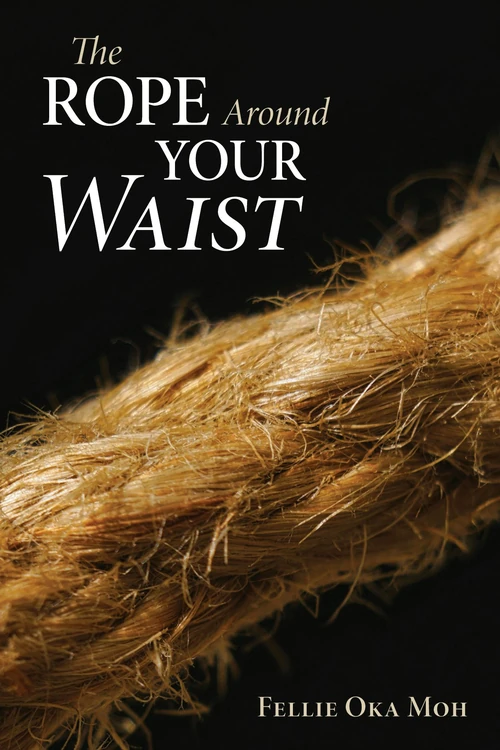
The Rope Around Your Waist
- Fiction
- Publisher: Resource Publications (Wipf and Stock)
- Published: 2021
FritzSearch.com earns a commission on purchases made through Bookshop.org links.
Publisher's Description
The novel interrogates the dynamics of challenging relationships, betrayals, forgiveness, and healing. When the pressure of having a male child becomes overwhelming, Adaugo seeks for ways to save her failing marriage. She blames her husband's infidelity on her inadequacies. The many marital challenges she experiences seem to be machinations of her fate. Nothing seems to save her marriage but Adaugo's love for her daughters. Will she leave, or will she stay to fight for her marriage? She turns to God and finds strength, not just to move on, but to extend forgiveness to her husband.
Endorsements (3)
“Fellie Oka Moh captures the emotional and social turbulence of marriages enmeshed in the battle between residual cultures and emergent modernization. The resultant destructive vortex threatens social harmony. After reading The Rope Around Your Waist, I recommend adding this novel to every family library for a preview to familial challenges and learning from the mistakes of others how to employ the wisdom embedded in it for amicable resolutions of compounded family conflicts.”
“The Rope Around Your Waist is a realistic portrayal of the challenges facing most marriages in Nigeria, in particular, and in Africa, in general. . . . Infidelity, betrayal, male-child preference, mother-in-law intrusion, and gender dynamics are all treated with precision and elaboration in the actions of the characters. . . . The novel stands in the same category as Mariama Ba’s So Long a Letter and Amma Darko’s Beyond the Horizon: novels that deal with the intimacy of women’s experiences in a patriarchal society. . . . An enthralling story of love, betrayal, and healing, where true love shines at the end. It is a book I will read over and over again.”
“A captivating narrative of the travails of the protagonist, Adaugo, who struggles against the restraining forces of patriarchy in an Africanist accommodating manner. Adaugo’s struggle to keep her marriage from collapsing represents the ubiquitous burden of marriage on women in African traditional contexts and is simultaneously a metaphor for the existential problems of humans, which often assume new dimensions rather than being resolved. The author weaves the narrative around the complex patriarchal society and integrates the vibrant tropical ecology to present a graphic, lucid, gripping story that you wouldn’t wish to drop once you’ve read the first few pages. I strongly endorse this novel not only as worthy entertainment but also as an important feminist narrative.”
See something wrong on this page? Report a problem