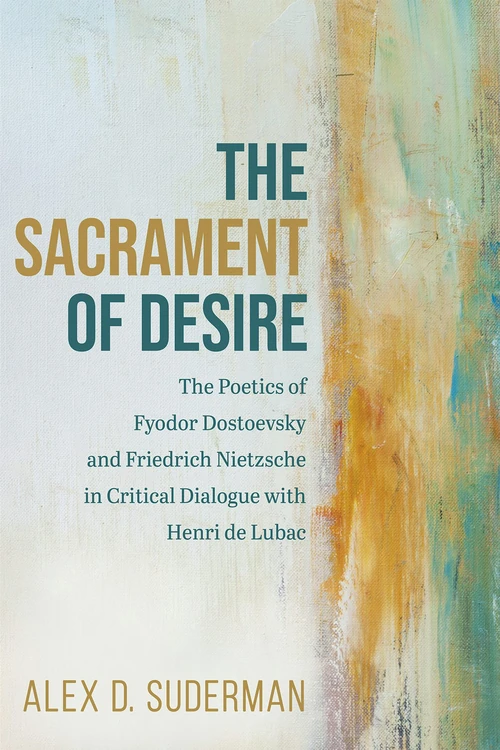
The Sacrament of Desire
The Poetics of Fyodor Dostoevsky and Friedrich Nietzsche in Critical Dialogue with Henri de Lubac
- Theology
- Philosophy
- Publisher: Pickwick Publications (Wipf and Stock)
- Published: 2022
FritzSearch.com earns a commission on purchases made through Bookshop.org links.
Publisher's Description
This book explores the political-theological implications of sacramental desire in Fyodor Dostoevsky`s The Brothers Karamazov with Friedrich Nietzsche's Thus Spoke Zarathustra in critical dialogue with Henri de Lubac. Suderman demonstrates how the work of de Lubac, Dostoevsky, and Nietzsche address a transcendent desire for a higher social and political unity in late-modern Western cultures and the imperialistic and coercive tendencies latent within it, concretely expressed in the Western church and the modern state. Specifically, this book investigates how Dostoevsky and Nietzsche envision new forms of political embodiment that are neither escapist nor imperialist. Through a detailed examination of Zarathustra's dramatic discovery of the eternal return and Alyosha's mystical experience of the resurrection, Suderman demonstrates the metaphysical significance of their respective political ethics. While the intent of de Lubac is to recover the social implications of the sacraments of Roman Catholicism, Nietzsche and Dostoevsky espouse alternative articulations of community and the sacramental desire necessary for such embodiment, a desire rooted in their respective perceptions of God.
Endorsements (2)
“Alex Suderman provides original close and comparative readings of Dostoevsky and Nietzsche as apocalyptic political visionaries. That he does so in critical conversation with Henri de Lubac’s thesis regarding Christian and anti-Christian humanisms is especially interesting for political theology and ethics.”
“Dostoevsky was among Christianity’s modern prophets, while Friedrich Nietzsche was its sworn enemy. In this bracing new study, Alex Suderman finds unexpected common ground between the creators of Alyosha Karamazov and ‘Zarathustra.’ Without playing down their profound differences, Suderman shows how Dostoevsky and Nietzsche together point the way to a vision of being human marked by friendship and sacramentally mediated desire. An intellectual and spiritual adventure.”
See something wrong on this page? Report a problem