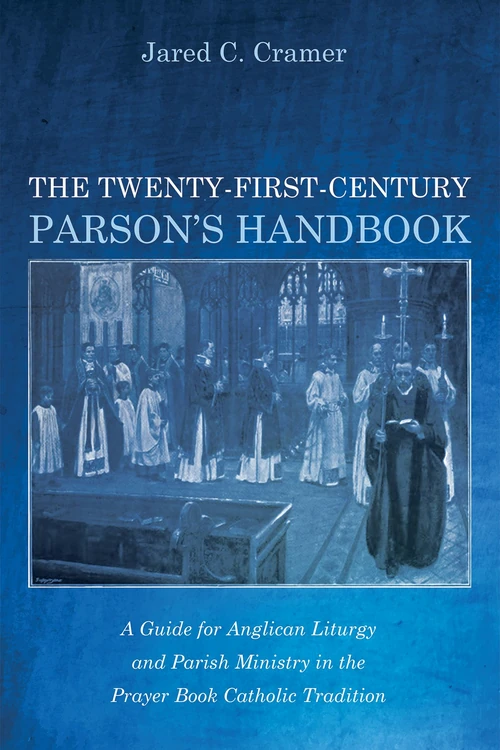
The Twenty-First-Century Parson’s Handbook
A Guide for Anglican Liturgy and Parish Ministry in the Prayer Book Catholic Tradition
- Preaching & Worship
- Publisher: Wipf and Stock
- Published: 2025
FritzSearch.com earns a commission on purchases made through Bookshop.org links.
Publisher's Description
When first published at the end of the nineteenth century, The Parson's Handbook went on to go through twelve editions, the final of which was published in 1932, four years before the death of its author, Percy Dearmer. In 1965, a thirteenth edition was published by Dearmer's student Cyril Pocknee. Now, nearly a hundred years after the publication of Dearmer's twelfth edition, Jared Cramer provides a new version of this work that will bring the insights of Dearmer's distinctively Anglican approach to worship to bear on the ministry of clergy and lay leaders in the twenty-first century. Entirely revised and rewritten with attention to the principals of modern liturgical theology and history, along with the ecumenical and multicultural context of today's Christian worship, this book demonstrates that the principles at the core of Dearmer's approach still can be of tremendous value to anyone who seeks to provide beautiful, dignified, and collaborative worship in the Anglican prayer book tradition.
Endorsements (2)
“Updating a classic text is a fraught and a delicate endeavor. Jared Cramer hasn’t reworked The Parson’s Handbook as much as he has translated it for a new generation. And what a lovely and deeply useful translation it is. Clergy from all across the spectrum will benefit from this wise and considered guide to worship that is reverent and recognizable to our Christian ancestors. Highly recommended!”
“With this book, Jared Cramer has given us a wonderful gift on so many levels. While the 1979 US Book of Common Prayer is removed in time and culture from Dearmer’s hopes for the 1928 Book of Common Prayer in the Church of England, the resounding center of Dearmer’s claim—that doing ceremonial with style and grace is important because beauty is important—crosses these differences. God is beauty, and to do the liturgy beautifully is to align ourselves with ‘the divine character of beauty.’ This book reminds us that we belong to an ‘episcopal’ church, not a tradition of local bespoke liturgies, and it continues the best of recent manuals on the liturgy in presenting not only the ‘how’ of liturgical celebration but, more importantly, the ‘why’ of how the beauty of God is manifested and reflected in our liturgies.”
See something wrong on this page? Report a problem