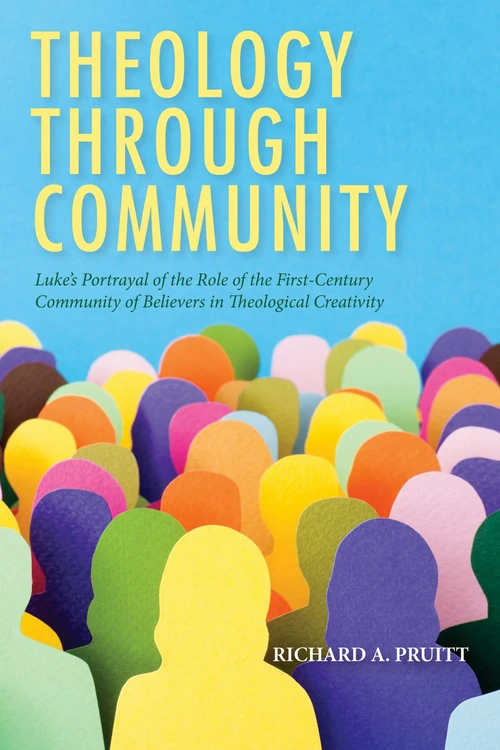
Theology through Community
Luke’s Portrayal of the Role of the First-Century Community of Believers in Theological Creativity
- Biblical Studies & Commentaries
- Publisher: Wipf and Stock
- Published: 2019
FritzSearch.com earns a commission on purchases made through Bookshop.org links.
Publisher's Description
Since the 1980s, renewal scholars have given considerable attention to the role of the believing community in the interpretive process. A broad consensus has emerged that a triad involving Scripture, the Spirit, and the believing community forms a cooperative relationship resulting in theological development, followed by commensurate action--identified in this research as theological creativity. In the context of this research, to be creative with theology is to take an existing theological assumption and broaden or adapt it to current circumstances, given the Spirit's evidential work and a consensual understanding of Scripture. But how does the community negotiate between Spirit and Scripture without subsuming either into its own predilections? For Luke, the first-century community of believers in Acts functions as an indispensable character in the formation of theological creativity. This work will demonstrate how Luke positions the community as a character in story form, between Spirit and Scripture, functioning as a bridge through which its testimony of the Spirit's evidential work and its application of Scripture interact. In order to illustrate this balancing act, we will use a modified configuration of the triadic notion: Spirit-Community-Scripture.
Endorsements (6)
“Carefully researched and clearly articulated, Pruitt’s monograph validates that the community in Acts functions as an active character with which the audience is to identify, thus showing how the community in Acts models the art of theological interpretation. The community is the necessary bridge for communication between the Spirit and Scripture, as well as the nexus that generates theological understanding in dialogue with the Spirit and Scripture. Pruitt’s monograph is a must read for those interested in theological hermeneutics in general and Pentecostal and Renewal hermeneutics in particular because he moves the conversation forward on how community functions in the interpretive process in significant ways.”
“The dissertation makes an original contribution in that it extends our understanding of how memory theory can be utilized to understand and reconstruct how the early church employed collective memory of sacred events to construct identity/ies. Not only does the work of Pruitt make an original contribution to the field, but it successfully evaluates and critiques the current research on this topic.”
“Building cordially upon prior work in this field, Pruitt’s book represents another important addition to the chorus of voices calling for, even demanding, a more mature approach to biblical and theological hermeneutics within Pentecostal/Charismatic traditions. His combination of clarity, nuance, and irenic tone allow for an accessible-yet-evocative appraisal of the role of the community in the theological process, an appraisal that bears significant implications for the application of Scripture in the contemporary world.”
“This persuasive study informs us that Acts is about much more than the acts of individual leaders, but rather describes an engaged community creatively involved in the act of interpretation to better understand the divine activity they had witnessed. Its portrayal of early Christian communities presents us with the challenge to develop similar communities trained in the Scriptures and attentive to the Spirit so that we can realize the promise of the prophetic community envisioned at Pentecost.”
“What role does the community play in theological creativity? In the context of current uncertainties, Pruitt uses Luke-Acts to show that the community can have—must have—a decisive role in theological creativity. With close attention to the text, Pruitt shows that, for Luke, the community functions as a hermeneutical bridge between its testimony of the Spirit’s work and its application of Scripture to a theological problem. This is an important book and should be read by all concerned with theological creativity, particularly in the Pentecostal and charismatic traditions.”
“Demonstrating the importance of the first-century community for theological development in the Acts of the Apostles, Theology through Community issues a clarion call to Pentecostals and others to focus attention on our communities as central to our theological identity and creativity, thereby demanding a renewed interest in the heritage, stories, and testimony that shape the church.”
See something wrong on this page? Report a problem