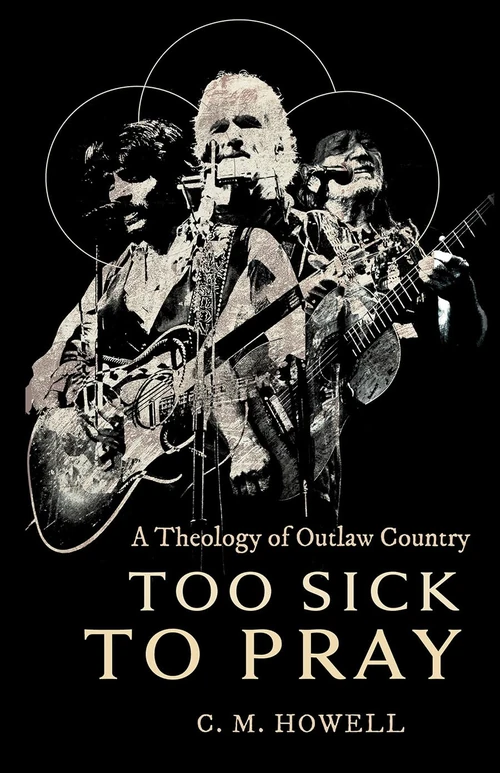
Too Sick to Pray
A Theology of Outlaw Country
- Arts & Literature
- Theology
- Publisher: Fortress Press (Augsburg Fortress)
- Published: 2026
FritzSearch.com earns a commission on purchases made through Bookshop.org links.
Publisher's Description
Too Sick To Pray: A Theology of Outlaw Country explores the imaginative world that comes to form in Outlaw Country--that musical expression of Nashville rebels in the 1970's. Far from being comprised of uneducated hillbillies singing recycled gospel songs, Outlaw Country is filled with Oxford scholars, literary geniuses, and poets in the making. The genre not only redefined the music industry it broke open the mold for political, social, economic, and, most importantly, theological topics in country music. C. M. Howell shows that the theological dimension of Outlaw Country can in no way be drawn in a straight line to more conventional, organized, or academic sense of Christian theology. Rather, Too Sick to Pray argues that the Outlaws are involved in a mode of theological play. Play, here, gathers three key functions: it is a form of aesthetic judgement, therein alleviating Outlaw Country from the burdens placed on more exacting forms of theology; it is a mode of phenomenological presence, signaling that Outlaw Country is full of aesthetic tension and hermeneutical possibilities; and it is a form of disinhibited productivity, a type of action which cannot be reduced to the aims of the agent, but one in which the agent discovers their own sense of identity.
Endorsements (3)
“Conversant with theology and musicology, aesthetics and honkytonks, C. M. Howell invites you to a smoky roadhouse where Tillich knocks back a few with Willie, beside Jüngel with Waylon, Pannenberg with Billy Joe, von Balthasar with Van Zandt. It's a helluva trip. How can you resist?”
“Howell captures the spirit of a group of songwriters who try not so much to make sense of the world as to make good on its lack of sense by playing with the biblical and religious fragments that have shaped their imagination. Howell's probing and sensitive analyses show that this kind of play, in turn, opens theology to a deeper engagement with the human condition.”
“Those of us who came of age with Outlaw Country know their brilliance as musicians and songwriters. We also know there was an intellectual, even academic, depth to the Outlaws--e.g., Kristofferson was a Rhodes Scholar. The Outlaws were not just musicians and intellectuals. They were, as C. M. Howell shows in this marvelous book, theologians and their theology a public theology. The Outlaws may have been in exile in Luekenbach, but they were never very far from God.”
See something wrong on this page? Report a problem