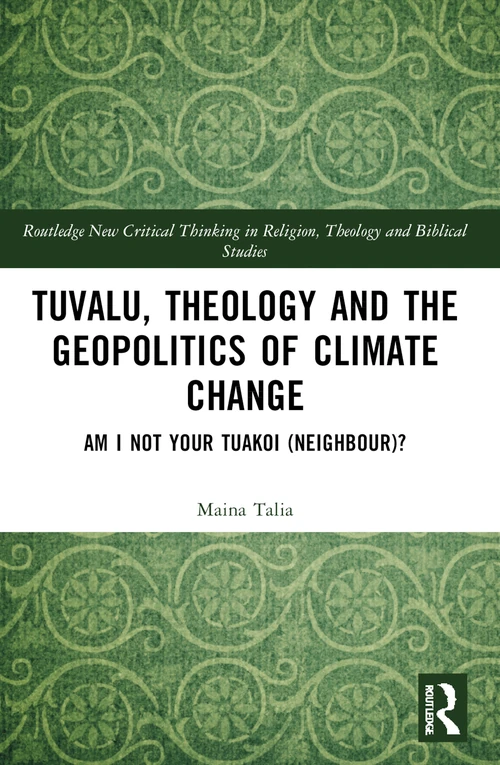
Tuvalu, Theology, and the Geopolitics of Climate Change
Am I Not Your Tuakoi (Neighbour)?
- Publisher: Routledge
- Published: 2026
FritzSearch.com earns a commission on purchases made through Bookshop.org links.
Publisher's Description
This book examines the threat posed by climate change to the low-lying islands of Tuvalu through a lens of what it means to be a neighbour. Those who live on Tuvalu are among the most vulnerable in the world to threats of rising sea levels and global climate change. Their carbon emissions are miniscule and they are ‘weak actors’ in terms of the geopolitics of climate change. The task in Tuvalu is to take seriously the prospect of the submergence of islands and the potential for cultural extinction. This prospect raises a network of interconnected questions to do with the rights of climate displaced persons and sovereignty over lands lost to climate change. In this volume, the author draws upon Indigenous knowledge, the ethics of climate justice, insights from climate science and familiarity with discourses surrounding the Anthropocene to explore the implications of the parable of the Good Samaritan. The rhetoric of the question ‘am I not your tuakoi (neighbour)?’ inserts a theological and moral dimension into the complex politics of climate change. The book will be of particular interest to scholars of theology, ethics, ecology and environment, as well as those working in Pacific studies, development studies, and politics.
Endorsements (4)
“Tuvalu may serve as the prime example of the need for inter-generational climate justice. But what could it possibly mean to give each their due amid sea level rise? Drawing from the parable of the compassionate Samaritan, indigenous wisdom, and lyric poetry, Maina Talia maintains that being good neighbours may well provide the key.”
“The low-lying islands of Tuvalu represent a microcosm of how dangerous climate change is threatening lands, peoples, cultures and humanity’s common history on earth our home. Suffering from threats of cultural extinction due to anthropogenic change caused by others, Oceanic islanders live not in the margins but in the midst of our common struggle for climate justice. Talia’s contextually and analytically gripping work offers a painfully demanding, highly relevant reflection on the ethical, political, and climatological depth of what it means to encounter the deadly power of global climate change. Will we stay in denial or open our eyes as neighbors?”
“Theologically accomplished and scientifically informed, Maina Talia writes of the imminent existential threat from rising sea levels to his people's way of life in Tuvalu. With its ethical plea, his moving response represents a major contribution to recent work in eco-theology. He deserves a wide audience.”
“This work by Maina Talia has, at its heart, the lived realities of Pacific people, who have a deep indigenous spirituality and strong Christian faith. In the work of Climate Justice, Science and Spirituality (Theology) are two sides of the same coin. Talia has woven this as his contribution to an important discourse that is founded on his own advocacy for climate justice based on the question to polluting countries: 'Are You My Neighbour?”
See something wrong on this page? Report a problem