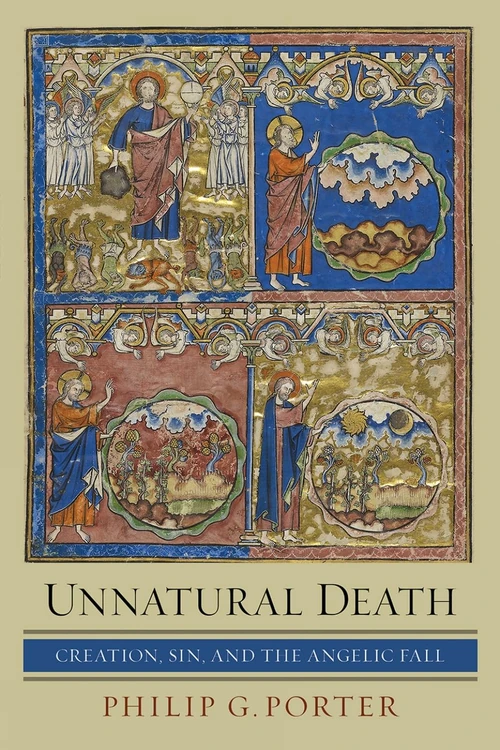
Unnatural Death
Creation, Sin, and the Angelic Fall
- Theology
- Publisher: Fortress Press (Augsburg Fortress)
- Published: 2025
FritzSearch.com earns a commission on purchases made through Bookshop.org links.
Publisher's Description
In Unnatural Death Philip Porter demonstrates sin and death to be intimate with one another; because of sin, creation is held in thrall by death. Demonstrating the intimacy of sin and death matters because Christians should take natural science seriously while also affirming essential doctrinal claims such as "The last enemy to be destroyed is death" (1 Cor 15:26). Death is not benign, and this book provides a robust theological grammar of scriptural interpretation, of voluntary and natural evils, and of time and eternity which allows Christians to claim that the damage done by death originates in creaturely sin. Porter argues that using Augustine's theory of the rationes seminales makes available new descriptive possibilities in the theology of creation. One way to understand this work is as a speculative picture of creation that accounts for death on evolutionary timescales without attempting to naturalize it. It offers this picture by showing how the angelic fall can account for the presence of death in creation. This work does not offer a theodicy. Instead it provides an analysis of the angelic fall that shows how God works through creaturely freedom to bring about goods that neither justify nor make sense of evil.
Endorsements (3)
“God did not make death” (Wis 1:13) and that “death came through sin” (Rom 5:13) be squared with what seems evident from evolutionary science: that death not only long predated the appearance of human beings on earth, but also is itself integral to the emergence of the human species, as a part of the process of natural selection? Many theologians, without rejecting evolution, have managed to avoid grasping the nettle of this challenge, or if they have, they have tended to presume that the Christian tradition offers scant resources for addressing it. In Unnatural Death, Philip Porter takes up this challenge by turning to figures in the Christian tradition—Augustine, above all—to address how death can haunt all creaturely existence from the outset and yet still not be “natural.” This genre-defying book manages to be at once philosophical, historical, and literary, but above all, theological, inquiring into God and God’s ways with the world.”
“There is no stronger biblical pairing than the intertwining of sin and death, and yet it is now routinely dismissed because it is thought to violate scientific theories of human origins. There could be no more timely book than this one. As it “seeks understanding” of this mystery of the faith, it provides intellectual insight allowing those tempted by scientific reductionism to see the compatibility of faith and reason even here, without rationalizing the mystery away. This will appeal not only to theologians and teachers, but to pastors and anyone else charged with offering a compelling defense of Christian faith.”
“page an unusual and lovely combination of conceptual precision, stylistic elegance, and intellectual energy.”
See something wrong on this page? Report a problem