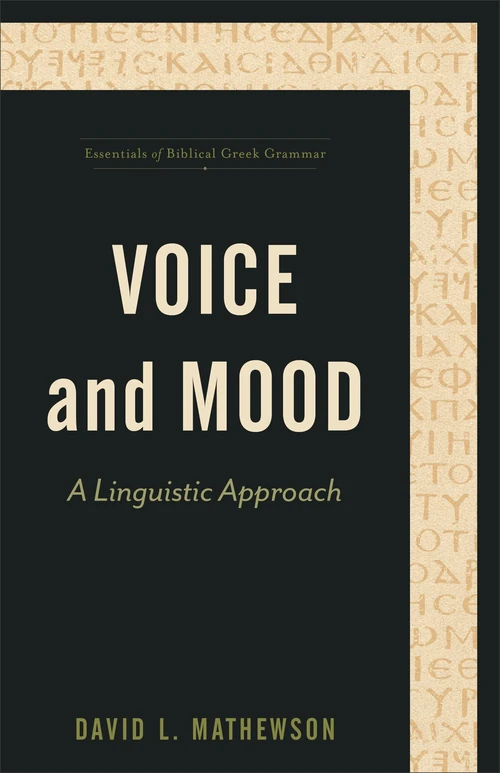
Voice and Mood
- Biblical Studies & Commentaries
- Publisher: Baker Publishing Group
- Published: 2021
FritzSearch.com earns a commission on purchases made through Bookshop.org links.
Publisher's Description
A recognized expert in Greek grammar examines two features of the Greek verb: voice and mood. Drawing on his years of teaching experience at a leading seminary, David Mathewson examines these two important topics in Greek grammar in light of modern linguistics and offers fresh insights. The book is illustrated with examples from the Greek New Testament, making it an ideal textbook for the intermediate Greek classroom. This is the first volume in a new series on Greek grammar edited by Stanley E. Porter.
Endorsements (3)
“It's difficult to write a grammar that both is accessible for students in the classroom and makes a genuine advancement in the linguistic study of biblical Greek. Mathewson nevertheless has written a superb textbook on Greek voice and mood that accomplishes these tasks.”
“Until a little over a century ago, the value of a book was directly related to how old (how tried and true) its wisdom was. Now, unless people stress how new a book's contents are, prospective buyers will ask, Why bother? In the field of the role of verbs in the Greek grammar of the New Testament, there is definitely an old and a new wisdom. Mathewson judiciously blends the best of each and produces a remarkably user-friendly synthesis of the two. An excellent inaugural volume for this new series, which may just establish itself as tried and true as well!”
“This is an excellent treatment of Greek voice and mood that strikes a useful balance. On the one hand, it is more informative than Greek grammars regarding these relatively neglected topics. On the other hand, it is more accessible and broadly conceived than typical academic monographs. Interested students will benefit greatly from Mathewson's linguistic approach to these two important topics for the study of Greek.”
See something wrong on this page? Report a problem