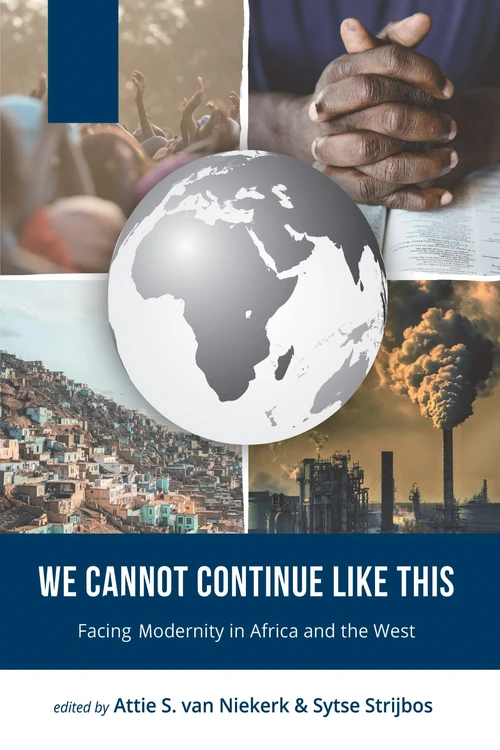
We Cannot Continue Like This
Facing Modernity in Africa and the West
- Ethics, Culture & Social Issues
- Publisher: Wipf and Stock
- Published: 2022
FritzSearch.com earns a commission on purchases made through Bookshop.org links.
Publisher's Description
We Cannot Continue Like This: Facing Modernity in Africa and the West is a scholarly book strongly focused on the context of Africa, with two chapters that are written by authors from the Netherlands for the purpose of a North-South dialogue. The main thesis of the book is based on the insight that the trajectory of modern development ought not to continue as it is. It is ecologically unsustainable and continues to enlarge the gap between rich and poor. The book centers on an academic analysis of current development practices, mostly in Africa. It addresses four topics that are often neglected in studies on development and sustainability: listening to voices from Africa to counter the hegemony of the Global North; recognizing the importance of spiritual issues in the secular affairs of society; deriving theory from data that was obtained and analyzed in a systematic way, and was compared with existing theories; and illustrating the importance of households rather than just governments, businesses or academic institutions. The manuscript seeks to integrate academic reflection and insights gained from practical involvement with sustainability issues in local communities and low-income households, with contributions from natural and social sciences and theology. The authors respond to the question: How can modern science and technology help to solve dilemmas such as unsustainable development?
Endorsements (1)
“The book is a fascinating account of human existence in an era of the Anthropocene. The title, We Cannot Continue like This, is simultaneously a normative statement and an emergency call, but also begs for deep reflection on the path that we as humans have chosen to walk. The title reprimands action and commands attention, so important for development practice. The ten chapters are a comprehensive attempt at making sense of the socio-ecological and socio-technical questions of the day. It also radiates a deep respect for poor households in their attempts at making a living. What also makes it a good read is the fact that scholars from the North and from the South have collaborated. This is an important book to understand the urge of human beings to make sense of the technology-society-cultural/philosophical confluences and consequences of our existence and progress. The main value of this book is that it encourages deep reflection on appropriate technology in the predominantly deprived communities of South Africa, as well as the underlying philosophical assumptions and paradigms that co-determine the relationships of households and communities with technological advancement on a planet that becomes more vulnerable.”
See something wrong on this page? Report a problem