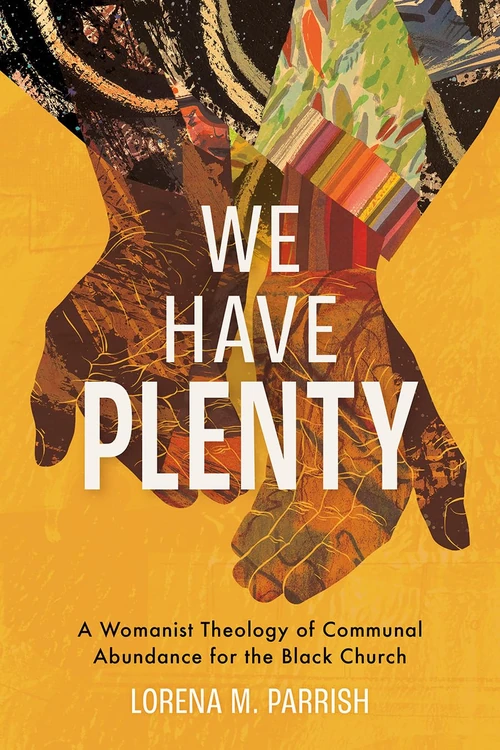
We Have Plenty
A Womanist Theology of Communal Abundance for the Black Church
- Theology
- Publisher: Fortress Press (Augsburg Fortress)
- Published: 2025
FritzSearch.com earns a commission on purchases made through Bookshop.org links.
Publisher's Description
The Black church often maintains an allegiance to white, Western approaches to wealth and material acquisition. In doing so, it can ignore Jesus's teachings on poverty, wealth, and materialism. The church's ambivalence toward Jesus's understandings of poverty and wealth uniquely impacts the spiritual and material well-being of Black women and the Black community. As a womanist theologian, Lorena Parrish argues that the Black church needs a new, liberative way forward. In We Have Plenty, Parrish traces the history of theologies of prosperity to help scholars and practitioners understand the long-standing appearance of prosperity gospels in the Western church. In doing so, she explores selected sermons and writings of St. Augustine, John Calvin, John Wesley, and Walter Rauschenbusch to show how theologies of prosperity have long been embedded in mainline Christianity, sometimes imperceptibly so. Parrish argues that recognizing these trajectories is critical for the Black church's capacity to foster pathways toward communal liberation and wholeness. Parrish offers a womanist theology that hearkens to the liberative work of Fannie Lou Hamer's Freedom Farm Collective and illumines contemporary initiatives that cultivate pathways toward Black communal abundance. Parrish shows how equipping Black church pastors and community leaders with tools to build similar strategies better positions the church and community, in turn, to promote more equitable human relations and communal asset-building and sharing. We Have Plenty offers a moral imagination for theologians, church leaders, and community activists to envision Black communal abundance and thriving in light of Jesus's teachings.
Endorsements (4)
“Wealth and the Gospel do not mix. Wealth is oil; the Gospel is water. The two can coexist, even peacefully, but they can never become one. Lorena M. Parrish’s treatment of this conundrum, especially challenging in the capitalistic plutocracy the United States is becoming, offers a womanist perspective on this ancient dilemma. When that happens, new ideas and new hope emerge. I came away from We Have Plenty with a better understanding of the Gospel and money, of womanist theology, and of the world in which we live.”
“Lorena M. Parrish aims to foster communal liberation and wholeness by adeptly probing the power and promise of God’s salvation. Discerning between contemporary theologies of prosperity and Jesus’s teachings on wealth renunciation, redistribution, and call for a radical reversal, Parrish lays a clear path to communal abundance built on tangible models of resistance and transcendence that face poverty and oppression foursquare faithfully.”
“Lorena M. Parrish provides us with new strategies to take seriously the suffering of prosperity theology that we choose to ignore. Adding her voice with Abisoye Ajayi-Akinfolarin, Majora Carter, and William Barber, Parrish explores the devastating challenges of wealth and poverty with keen insight and substantive womanist prowess concerning the unique harms to Black women, Black churches, and all communities. Parrish’s fluid writing disturbs – provoking action action and insisting upon social change and theological re-imagination. With this very accessible resource, no more should theologies of prosperity go unchecked in our theological and religion classrooms. Nancy Lynne Westfield, director, Wabash Center for Teaching and Learning in Theology and Religion, and author of Glimpses of Me and Mine We Have Plenty is a groundbreaking work that challenges the Black Church to reimagine abundance beyond the limits of prosperity gospel ideology. With womanist theological depth and prophetic urgency, Lorena M. Parrish examines the historical ambivalence toward Jesus’s teachings on wealth and poverty and presents a compelling vision of communal plenty rooted in justice, redistribution, and radical love. This is a timely must-read for scholars, clergy, and anyone seeking to align faith with liberation.”
“Professor of Formation, Leadership, and Culture, and director, Center for the Church and the Black Experience, Garrett-Evangelical Theological Seminary We Have Plenty should be read by all. It is particularly attuned to ongoing Black longing for abundant living that resides in practices of Black faith—from some community’s attraction to empty prosperity preaching to other Black faith community’s commitment to sharing and caring as hallmarks of religious practice. Importantly, this book was birthed from the womb of first-generation womanist theology, which was both an academic project and a movement of Black women scholars who gathered at tables of abundance—abundant hospitality and belonging among each other, abundant experience of loving God and Black people, abundant concern for the godly and daily survival of Black women. It is a gift to the reader that the teaching and inspiration of Delores Williams rings clearly throughout this text. This book is Lorena M. Parrish’s twenty-first century encounter and expansion of first-generation womanist thought. In offering models of resistance and transcendence centered in Black Christian women’s experience, We Have Plenty points toward models that can sustain us in continuously treacherous times for Black lives.”
See something wrong on this page? Report a problem