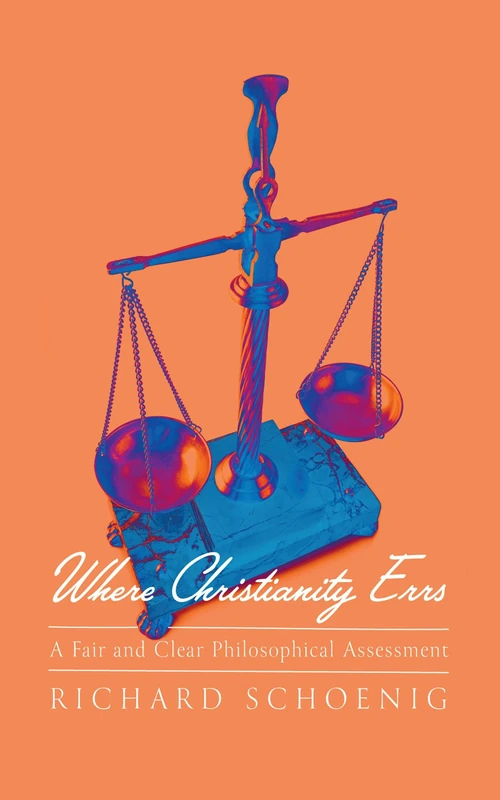
Where Christianity Errs
A Fair and Clear Philosophical Assessment
- Philosophy
- Publisher: Wipf and Stock
- Published: 2024
FritzSearch.com earns a commission on purchases made through Bookshop.org links.
Publisher's Description
Where Christianity Errs comprises a group of essays that aim to carefully, clearly, fairly, and without rancor argue that Christianity has significantly erred in some of its important beliefs and activities. Among the topics assessed are original sin, prayer, faith, hell, the meaning of life, Christian apologetics, Christian ethics, Christianity and politics, and Christianity and atheism. This book contains novel arguments and insights that will be of interest to non-specialists as well as those who have some background in religion and the philosophy of religion.
Endorsements (3)
“This is an important book. Thorough yet succinct. Every chapter is well argued. And Schoenig covers many topics that tend to be under-addressed, making this an essential addition to any counter-apologetics library.”
“Richard Schoenig’s Where Christianity Errs is fair and clear. It is also a powerful and penetrating critique. Broad in scope, detailed in content, and reasonable in tone, the book does not pick at weak spots but boldly confronts what appear to be Christianity’s strongest points. Schoenig takes on Christianity’s ablest defenders and offers cogent rebuttals. Where Christianity Errs is must reading both for unbelievers and for Christians.”
“Richard Schoenig’s comprehensive Where Christianity Errs respectfully and dispassionately weaves together decades of perceptive thinking into a compelling case against the existence of the Christian God. Masterfully incorporating contemporary moral philosophy and philosophy of religion, Schoenig manages to accessibly weave together a number of novel arguments about long-neglected topics indispensable to the Christian faith. Internal inconsistencies and those between core Christian tenets and the nature of our world substantiate the unsoundness of central Christian beliefs.”
See something wrong on this page? Report a problem