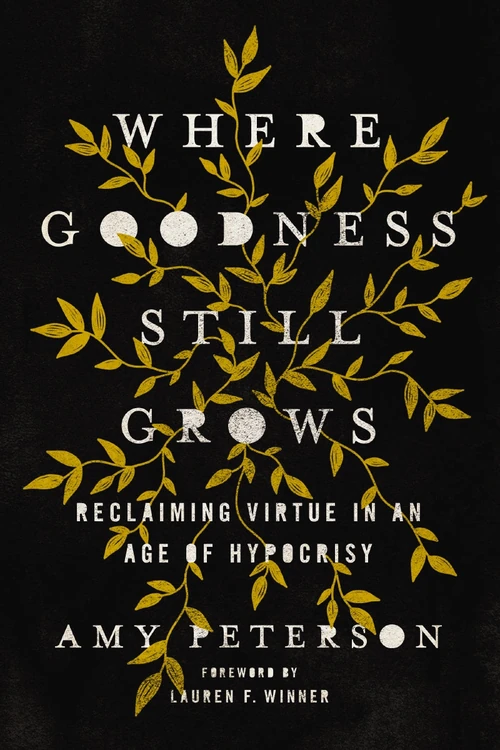
Where Goodness Still Grows
Reclaiming Virtue in an Age of Hypocrisy
- Ethics, Culture & Social Issues
- Publisher: W Publishing Group (Thomas Nelson)
- Published: 2021
FritzSearch.com earns a commission on purchases made through Bookshop.org links.
Publisher's Description
Declining church attendance. A growing feeling of betrayal. For Christians who have begun to feel set adrift and disillusioned by their churches, Where Goodness Still Grows grounds us in a new view of virtue deeply rooted in a return to Jesus Christ’s life and ministry. The evangelical church in America has reached a crossroads. Social media and recent political events have exposed the fault lines that exist within our country and our spiritual communities. Millennials are leaving the church, citing hypocrisy, partisanship, and unkindness as reasons they can’t stay. In this book Amy Peterson explores the corruption and blind spots of the evangelical church and the departure of so many from the faith - but she refuses to give up hope, believing that rescue is on the way. Where Goodness Still Grows: Dissects the moral code of American evangelicalism Reimagines virtue as a tool, not a weapon Explores the Biblical meaning of specific virtues like kindness, purity, and modesty Provides comfort, hope, and a path towards spiritual restoration Amy writes as someone intimately familiar with, fond of, and deeply critical of the world of conservative evangelicalism. She writes as a woman and a mother, as someone invested in the future of humanity, and as someone who just needs to know how to teach her kids what it means to be good. Amy finds that if we listen harder and farther, we will find the places where goodness still grows.
Endorsements (8)
“In this poignant, honest book, Amy Peterson confronts her disappointment with the evangelical leaders who handed her The Book of Virtues then happily ignored them for the sake of political power. But instead of just walking away, Peterson rewrites the script, giving us an alternative book of virtues needed in this moment. And it’s no mistake that it ends with hope.”
“If the church of your childhood has broken your heart—particularly, politically—if your faith foundations have been shaken by betrayal and complicity, it might seem quaint to turn toward virtues. And yet what are we yearning for but embodied goodness? Amy has given us a well-researched, beautifully written, strong book about the virtues necessary for the apocalypse. We need to lean in further to discernment, lament, love, and hospitality, not in a weak be nice sort of way but in the muscular, lean way that holds on to hope out of faith disguised as sheer stubbornness. This book is one part lament, one part hope, and entirely necessary for these days.”
“Readers will find [Peterson’s] courageous exposure of American evangelicalism’s watered-down version of Christianity eye-opening, convicting, refreshing, and inspiring.”
“Amy Peterson reflects the best of the church’s next generation. With biblical faithfulness and wisdom, Where Goodness Still Grows gently critiques the shortcomings of the generation who came before her, then lovingly points the way toward a more holistic and virtuous future for all who claim the name of Christ.”
“Deconstructing is becoming a new normal; re-envisioning a path forward in the shadow of tradition is increasingly rare. Through gorgeous prose and widening her scope to a diverse array of voices, Peterson is doing the hardest work of all: stubbornly clinging to faith while holding it accountable at the exact same time. This book is vital reading.”
“Set against a culture where truth is for sale and faith trades down for power, this exquisite book invites us to abandon fear, cultivate curiosity, and learn to connect. If you’re searching for signs of life, you will find them here.”
“Amy Peterson’s reflective, impassioned book is for anyone who, like me, both loves the evangelical Christian movement in which you were raised and also grieves its compromises and inconsistencies. It is one of the most genuinely hopeful books I’ve ever read: clear-eyed about Christian complicity in evil, resolute in its determination to recover the good in spite of the church’s failures, and visionary in its attempt to imagine a better future.”
See something wrong on this page? Report a problem