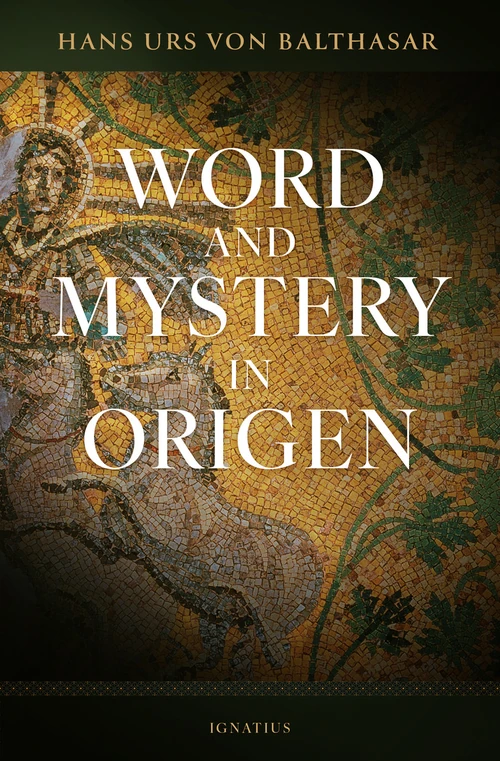
Word and Mystery in Origen
- Theology
- Publisher: Ignatius Press
- Published: 2026
FritzSearch.com earns a commission on purchases made through Bookshop.org links.
Publisher's Description
In the history of Western thought, there exists a lineage of systems in which obscurity is not merely accidental. The aim is not to withhold a truth—clear in itself—from the uninitiated, but rather to demonstrate, with the utmost clarity, how the Mystery conceals itself. Several Greek Fathers belong to this tradition: Gregory of Nazianzus, Gregory of Nyssa, Dionysius the Areopagite, and, above all, Origen. The purpose of this study, therefore, is to organize Origen’s major theological ideas around the concept of Mystery. The approach adopted is not purely historical; for although Origen’s thought is lucid and synthetic, it is not systematic in the strict sense. It will be necessary to highlight certain features and condense specific ideas into expressive formulations that do not appear verbatim in Origen’s own vocabulary. This method seeks only to reveal—through language more familiar to our own age—the deepest aspirations of this great theologian, for whom God was simply "Light and Fire: fire for all impurity, and light without shadow for the saints."
Endorsements (2)
“The development of the spiritual interpretation of the Scriptures has no more important master than Origen of Alexandria. Balthasar's study of Origen was meant to persuade the unconvinced—whether they were worried that Origen's cosmological speculations altogether vitiated his theology or that his allegorism led him into fantasy, not to say farce. It is now in English translation, preceded by a quite indispensable introduction and presented with immense scholarly care: a treasure for both patrologists and Balthasarians.”
“Hans Urs von Balthasar began his theological career re-sourcing the Church Fathers of East and West in a flurry of articles, books, translations, and anthologies. Arguably the Church Father who captured his imagination the most was Origen of Alexandria. One cannot understand Balthasar, whom Thomas Merton instinctively called an “Origenist,” without attending to his lifelong engagement with Origen. With an elegant translation, a learned foreword, and expanded footnotes, Samuel Pomeroy brings Balthasar’s contribution into dialogue with contemporary patristic scholarship. If Balthasar was correct, we still have not caught up with Origen.”
See something wrong on this page? Report a problem