June-Ann Greeley
Theology
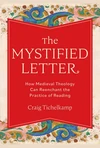
“In The Mystified Letter, Tichelkamp succeeds in making a persuasive, accurate, and quite worthy case for a "re-enchantment" of the practice of reading by retrieving the mystical ethos of reading that existed in monastic communities during the Middle Ages, specifically within the culture of the Victorine School in twelfth-century Paris. Such a retrieval, as Tichelkamp correctly explains, is not the imposition of a more "traditional" set of values onto the effects of contemporary culture; rather, it is the distilling of essential ideas and practices for the "radical" renewal of understanding: here, the author utilizes the medieval monastic understanding of reading as a sacred, potentially mystical relationship between the text and the reader and among a community of readers. Tichelkamp rightly reminds us that in medieval schools, reading both sacred and secular literature was a practice that allowed spaces of mystery and incomprehensibility, that welcomed communion and conversation, but that did not always seek--as we do now--the absolute surety of specific interpretation, forms of analyses that tend to incite division and disagreement. The medieval world regarded the text as sacred and capable of spiritual inspiration as well as moral transformation, which depth of thinking about reading, Tichelkamp argues, we must attempt to recover. Reading, he enthuses, must again become an imaginative as well as cognitive experience, the occasion for wonder and awe and delight, and not only, as happens now too often, simply for technical and perfunctory purposes. For Tichelkamp, the generally medieval but specifically Victorine ease with a mystical sensibility in all matters of life--that is, beginning with the mundane and literal but then seeking and looking beyond the apparent to the unseen and the ineffable--is an attitude that must again be cultivated not just in churches and schools but in contemporary culture altogether. He wants to shock contemporary culture out of its apathy, indifference, and sullen antagonism toward reading and to regain the sense of mystery and wonder that has always been present in the written word, at least as medieval thinkers argued. As the Victorines taught and Tichelkamp recommends, readers should again "ramble" and "wander" along literary paths--fiction, poetry, drama, and all other forms--not always seeking an "answer" or the correct "interpretation" but rather allowing the dignity and the phenomenon of the text to be present before the reader, salvaging the text from constant deconstruction and destabilization. Reading need not always have just the goal of completion in mind: sometimes, as the Victorines taught, it is sufficient just to linger over a verse or a phrase or a description and revel in that singular moment. This is a worthy text not only for educators and institutional leaders who have been frustrated with the disaffection with reading that has pervaded current mores, especially among the young, but for anyone who hopes to (re)gain the mystical wonder of the text and the transformative power of reading.”
No books by this person in our catalog yet.
See something wrong on this page? Report a problem