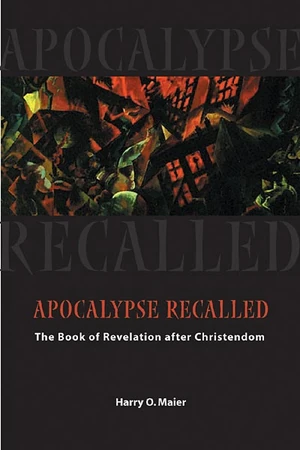
Apocalypse Recalled
The Book of Revelation after Christendom
- Biblical Studies & Commentaries
- Publisher: Fortress Press (Augsburg Fortress)
- Published: 2002
FritzSearch.com earns a commission on purchases made through Bookshop.org links.
Publisher's Description
The Book of Revelation has often been read as a set of endtime scenarios, glorifying a vengeful God and predicting and even fomenting apocalyptic violence. Yet it continues to exert a profound hold on the dreams and visions, fears and nightmares of our contemporary, first-world, secular culture. Harry Maier insists that, however much one is skeptical of its misuse or awed by its influence, Revelation still harbors a powerful and important message for Christians today. His fascinating book, erudite yet also intensely personal, asks us to recall Apocalypse through a careful exegesis of Revelation's deeper literary currents against the backdrop of imperial Rome. He explores the narrrator's literary identity, the plot or journey of the text, its many ocular and aural dimensions, and the ambiguous temporal dimensions of its "past vision of a future time." Revelation, he believes, "offers an inversion of the violent and militaristic ideals of a first-century Roman Empire by offering a highly ironical political parody of imperial politics and insisting the true power belongs to the hero of the Apocalypse, the Slain Lamb." In the end, Apocalypse Recalled seeks to free the imprisoned John of Patmos and employ his massively influential and controversial text to awaken a sleeping, sidelined, and culturally assimilated church to new imperatives of discipleship. Key Features A responsible study that rescues the Book of Revelation from fundamentalist interpretations A call to understand and emulate the early church's relationship to political power A creative hypothesis about the literary character of the book
Endorsements (1)
“Maier reads the Book of Revelation reading Maier. He lets its ancient witness to an anti-imperial Christianity reread Christian life in the current empire of globalization. In this adventurous return to an Apocalypse we never left, Maier captures the subversive excitement of the text. His own writing is lively with popular culture and personal anecdote, rich in its transdisciplinary scholarship, prophetic but never heavy-handed in its 'cruciform irony.'”
See something wrong on this page? Report a problem