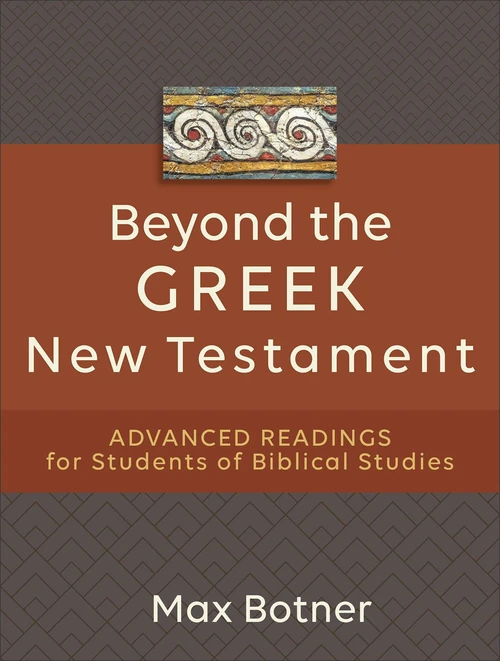
Beyond the Greek New Testament
- Biblical Studies & Commentaries
- Publisher: Baker Academic (Baker Publishing Group)
- Published: 2023
FritzSearch.com earns a commission on purchases made through Bookshop.org links.
Publisher's Description
Many New Testament Greek students have laid the groundwork necessary to read other ancient Greek texts, and yet they shy away from it. In this book, an expert in Greek teaches those students to read beyond the New Testament, showing both how to do it and why it matters. This helpful Greek language resource equips students to read and enjoy the vast corpus of ancient Greek literature. It covers a variety of relevant texts from the Septuagint and the Apostolic Fathers to Homer and Ignatius, making it a perfect supplemental text for courses on Greek or New Testament backgrounds. The book also considers the specific challenges students face when they seek to read complex Hellenistic and classical texts. Each reading includes a brief introduction to the text, suggested readings, and extensive footnotes that provide key points of grammar, vocabulary help, and cross-references to major Greek grammars. Students will acquire a greater capacity to read larger portions of Greek text and the confidence that no text or author is beyond their reach.
Endorsements (5)
“For many students, the Greek New Testament and the Septuagint are as far as they venture in Greek studies, but the world beyond the Greek Bible is so big. Enter Max Botner’s wonderful resource, Beyond the Greek New Testament. Botner introduces a wide array of texts, beginning with the Septuagint and the Apostolic Fathers and continuing with the OT Pseudepigrapha, Philo, Josephus, and classical historians, philosophers, poets, and playwrights. Botner introduces each corpus and guides students through the necessary grammar and vocabulary. He makes a compelling case that going beyond the Greek New Testament is one of the best ways to gain proficiency and the motivation to continue one’s Greek journey well beyond seminary studies. As I read this book, I felt the excitement that I felt when I first started reading Greek texts, when I sensed a vast new world opening up before me. I wish that this book had been available then! It will certainly be a valuable resource now.”
“I love this textbook! This is a phenomenal way to introduce students both to more advanced Greek readings and to significant ancient texts that are outside the Greek New Testament. Serious students will come away with an increased ability to read Greek and with a wealth of insight about the ancient world.”
“This is the book I wish I’d had when I was teaching Greek to university and seminary students. It beckons the new generation into a kind of intellectual maturity: understanding not only the New Testament but also the world in which it was birthed. That’s what we need if we, today, are to relate the Scriptures to our world. This book is a gift that will keep on giving.”
“Botner’s premise is that reading beyond the Greek New Testament equips you to read it more skillfully. This book provides an incredible incredible spread of texts to do just that, with readings from the Septuagint, the Apostolic Fathers, Jewish and Greek historians, and Greek poets. Even more, Botner demonstrates his own skill by providing masterful introductions, notes, and glosses. Anyone who picks up this book will have an exceptional resource for improving their Greek. It should be a standard textbook for any advanced Greek class.”
“With Beyond the Greek New Testament, Max Botner fills an important niche in Greek studies. He eases the way into secular Greek for those previously exposed primarily to New Testament Greek. With helpful introductions, notes, and vocabulary for a wide range of texts, both prose and poetry, chosen carefully for their relevance to students of New Testament Greek, Botner skillfully opens up the broader Greek world for an audience that will surely profit from learning about the social and linguistic environment in which the New Testament was composed.”
See something wrong on this page? Report a problem