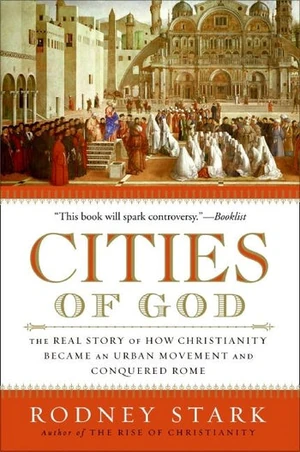
Cities of God
The Real Story of How Christianity Became an Urban Movement and Conquered Rome
- History & Biography
- Publisher: HarperOne
- Published: 2007
FritzSearch.com earns a commission on purchases made through Bookshop.org links.
Publisher's Description
How did the preaching of a peasant carpenter from Galilee spark a movement that would grow to include over two billion followers? Who listened to this \"good news,\" and who ignored it? Where did Christianity spread, and how? Based on quantitative data and the latest scholarship, preeminent scholar and journalist Rodney Stark presents new and startling information about the rise of the early church, overturning many prevailing views of how Christianity grew through time to become the largest religion in the world. Drawing on both archaeological and historical evidence, Stark is able to provide hard statistical evidence on the religious life of the Roman Empire to discover the following facts that set conventional history on its head: Contrary to fictions such as The Da Vinci Code and the claims of some prominent scholars, Gnosticism was not a more sophisticated, more authentic form of Christianity, but really an unsuccessful effort to paganize Christianity. Paul was called the apostle to the Gentiles, but mostly he converted Jews. Paganism was not rapidly stamped out by state repression following the vision and conversion of the Roman Emperor Constantine in 312 AD, but gradually disappeared as people abandoned the temples in response to the superior appeal of Christianity. The \"oriental\" faiths—such as those devoted to Isis, the Egyptian goddess of love and magic, and to Cybele, the fertility goddess of Asia Minor—actually prepared the way for the rapid spread of Christianity across the Roman Empire. Contrary to generations of historians, the Roman mystery cult of Mithraism posed no challenge to Christianity to become the new faith of the empire— it allowed no female members and attracted only soldiers. By analyzing concrete data, Stark is able to challenge the conventional wisdom about early Christianity offering the clearest picture ever of how this religion grew from its humble beginnings into the faith of more than one-third of the earth's population.
Endorsements (5)
“Rodney Stark’s Cities of God is clear, crisp, and easily read, as well as wise, balanced and convincing. It is the most current and most accessible study of the origins of Christianity. Stark, never intimidated by received opinion, startles Christians by his argument that Saint Paul was less a crucial figure than hitherto believed, and discomfits contemporary scholars who argue that early heretics had a more valid understanding of Jesus than traditional Christianity did. Secret religions, Stark proves, are less valid and less valuable than the public ones that win out. All of his arguments are convincingly supported by statistical studies, which however never intrude themselves on the lively narrative. This is the best book on early Christianity that I’ve read in half a century as a scholar. It is a rare masterpiece.”
“In this provocative study a preeminent expert on the sociology of modern religious movements offers unique insights on understanding the early success of Christianity. The book is essential reading for anyone seriously interested in exploring how statistical methods might illuminate important questions about even ancient religious movements and their world.”
“Once again, Stark brings a lively mind and rich experience as a sociologist of religion to bear upon analysis of early Christianity. His questions and approach are distinctive, and his proposals are often provocative and always stimulating.”
“Rodney Stark’s ongoing challenge of the conventional wisdom in the field of early Christianity is highly innovative, intensely provoking and strikes, in several ways, at the heart of the traditional view of nature of the early Jesus movement. This book is a ‘must read’ for anyone interested in the rise of Christianity.”
“Rodney Stark has been publishing a series of exciting books, using the skills of a sociologist to give a fresh interpretation of Christian history. This volume traces the urban beginnings of Christianity, its characteristics, the ethnicity of its numbers, and the vitality of its early life. He also shows its appeal to reason, which persuaded many intelligent and educated people to choose the Christian way as the intellectually superior way, and to make it their own.”
See something wrong on this page? Report a problem