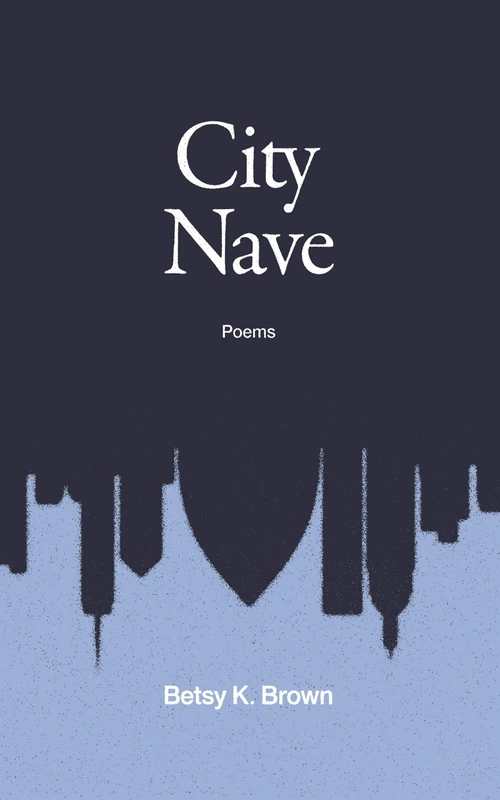
City Nave
Poems
- Arts & Literature
- Publisher: Resource Publications (Wipf and Stock)
- Published: 2024
FritzSearch.com earns a commission on purchases made through Bookshop.org links.
Publisher's Description
In City Nave, Betsy K. Brown explores the architecture of buildings, poems, and souls. Shape makes meaning--in the ornate corridors of cathedrals, the stark expanse of airports, the tidy monastic cells of sonnets, the spiraling stairs of terza rima, and the cluttered corners of memory. City Nave walks the reader through these places in an ongoing search for stories, stability, and sustenance.
Endorsements (9)
“Betsy K. Brown’s City Nave is a collection of poems that span many shapes and approaches, sometimes a ‘whisper / just wise / enough to feel real,’ sometimes ‘mariachi and trashcan drums and rap / And something that could maybe be worship.’ In this synoptic collection, which conceives of the human pupil as ‘the tunnel with light at both ends,’ we get to witness a promising debut.”
“Betsy K. Brown’s debut collection introduces a poet capable of deep love: love of the students who enter her classroom, of nature, of cities and buildings. In formal and free verse, Brown turns the clear eye of love towards the things of the world around her, revealing both their flaws and their luminous beauty so clearly that we cannot but see—and love—them too.”
“The poems in City Nave twist and slither off the page, never still, ablaze one breath and ashen the next, here admonishing, there searching, always, like a Phoenix, fiery, always re-birthing.”
“When I met Betsy K. Brown, I had no idea, as one cannot at first, that within her was a quarrel with herself that has led her to a sublime, fierce poetry of Catholic faith—but there is. Her unsettled, intense, and thoughtful quarrel with herself plays itself out in every dimension: rhetoric, description, metrics, themes, and more.”
“This poetry collection by Betsy K. Brown is something worth sitting up and noticing. Brown writes poems with an easy, contemporary sensibility that’s like chatting with someone you know and like. But wait a second! There’s something more. Formal structures and old ways, long forgotten ideas, the scent of the ruins of a civilization we once knew. A graceful and agile tone delivering tense and taut content. This is what poems are supposed to be.”
“Brown’s deployment of traditional forms—sonnet, shape form poems, terza rima, etc.—engages the poetic tradition both structurally and affectively, as her individual talent candidly recognizes the standards by which she would be measured. The poet consciously speaks of the poet’s craft of order, insight, and surprise—with plenty of all three in City Nave.”
“Infused with the humor of a teacher who spends her days among children and the eye of a poet who finds transcendent glory and prayer all around her even in the drought-ridden desert and the suffering of a lost one, Betsy K. Brown brings a gorgeous tapestry of experience witnessed by a wise and observant eye.”
“Betsy K. Brown is a poet of crisp clarity and formal jubilance. The poems in City Nave are all beautifully, prayerfully rooted in the details of our earthly existence and the breadth of our reach towards the transcendent. Their radiant vision moves from saints to mothers, from praise to elegy, from the wise voice of a child in the womb to contemporary psalms seeking the sacred.”
“Betsy K. Brown’s poems put flesh on the claim that art redeems life. Brown wins the world back by situating us relationally—a child from within her mother’s womb, a sister in flight above the earth below, a neighbor before a broken man. Visions rise from within and from beyond—from within a tent looking out, beneath the stars, in a hummingbird’s garden, among the city’s forgotten places, in memory of a student who died, facing new life in a new home, praying old prayers in God’s house and among his Saints. Each poem is like a beatitude, a selfless gift met by the promise of blessing.”
See something wrong on this page? Report a problem