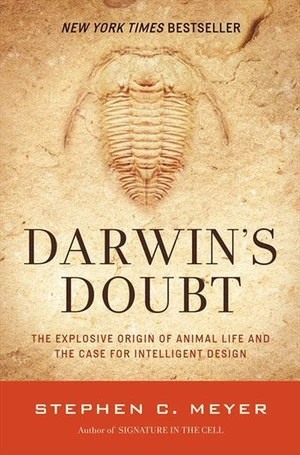
Darwin's Doubt
The Explosive Origin of Animal Life and the Case for Intelligent Design
- Science & Faith
- Publisher: HarperOne
- Published: 2014
FritzSearch.com earns a commission on purchases made through Bookshop.org links.
Publisher's Description
When Charles Darwin finished The Origin of Species, he thought that he had explained every clue, but one. Though his theory could explain many facts, Darwin knew that there was a significant event in the history of life that his theory did not explain. During this event, the “Cambrian explosion,” many animals suddenly appeared in the fossil record without apparent ancestors in earlier layers of rock. In Darwin’s Doubt, Stephen C. Meyer tells the story of the mystery surrounding this explosion of animal life—a mystery that has intensified, not only because the expected ancestors of these animals have not been found, but because scientists have learned more about what it takes to construct an animal. During the last half century, biologists have come to appreciate the central importance of biological information—stored in DNA and elsewhere in cells—to building new animal body plans. Expanding on the compelling case he presented in his last book, Signature in the Cell, Meyer argues that the origin of this biological information, as well as other mysterious features of the Cambrian event, are best explained by the theory of intelligent design, rather than purely undirected evolutionary processes. Meyer’s groundbreaking case for intelligent design is built on: The Mystery of the Missing Fossils: A deep dive into the Cambrian fossil record, where complex animals appear suddenly without the ancestral precursors Darwin’s theory requires. The Cambrian Information Explosion: An exploration of the explosion of digital information—the genetic code—required to build the new animal forms of the period. The Failure of Neo-Darwinian Theory: A rigorous critique of why the mutation and selection mechanism fails to produce the new genetic information and body plans that arose in the Cambrian period. A New Theory of Biological Origins: A powerful and evidence-based case for intelligent design as the best explanation for the origin of the information and complexity we see in the history of life.
Endorsements (17)
“It’s hard for us paleontologists to admit that neo-Darwinian explanations for the Cambrian explosion have failed miserably....Meyer describes the dimensions of the problem with clarity and precision. His book is a game changer.”
“Darwin’s Doubt represents an opportunity for bridge-building rather than dismissive polarization—bridges across cultural divides in great need of professional, respectful dialogue—and bridges to span evolutionary gaps.”
“Meyer writes beautifully. He marshals complex information as well as any writer I’ve read.... This book—and his body of work—challenges scientism with real science and excites in me the hope that the orgins-of-life debate will soon be largely free of the ideology that has long colored it...a wonderful, most compelling read.”
“Darwin’s Doubt is by far the most up-to-date, accurate, and comprehensive review of the evidence from all relevant scientific fields that I have encountered in more than forty years of studying the Cambrian explosion. An engaging investigation of the origin of animal life and a compelling case for intelligent design.”
“Steve Meyer’s book is a much–anticipated bombshell that details the swarm of problems of Darwinian evolution and also presents the case for intelligent design. Ask yourself: how often does a book of this kind receive a warm welcome from leading geneticists and paleontologists? Never, until now!”
“Stephen C. Meyer is brilliant and his latest book, Darwin’s Doubt is a must read.”
“A great book on the origin of animal life and crises of Darwin evolution; very clear, factual, comprehensive, logical, and informative. An enjoyable reading for both non–expert and expert.”
“Stephen Meyer’s new book, Darwin’s Doubt , is a fascinating and rigorous study demonstrating not only that biologists and paleontologists do not have an adequate explanation for the Cambrian Explosion, but that there is an alternative view that makes more sense.”
“Meyer is a talented writer with an easygoing voice who has blended interesting history with clear explanations in what may come to be seen as a classic presentation of this most fundamental of all debates.”
“Dr. Meyer has written a comprehensive and up–to–date analysis on the massive scientific evidence revealing the total failure of the neo–Darwinian explanation for life’s history. Darwin’s Doubt is important, clearly written with sound arguments, excellent illustrations and examples that make the topic easily understandable even for non–specialists…Randomness as a source for biological innovations is a present day paradigm and its supporters have too much at stake to give it up easily. The vague claims of Darwinian evolution refer to historical developments and as such are hard to prove. However, molecular biology has given us tools to experimentally test its claims. As so convincingly shown by Dr. Meyer the experimental evidence refers to intelligence—not randomness.”
“It is no secret among professionals that recent findings by developmental and molecular biologists are challenging current Darwinian theories of evolution. Meyer has condensed the research, made it accessible to the non-specialist and put it in the context of the debate over the origins of biological novelty. He makes a case for intelligent design as the only currently viable scientific theory for the origin of biological novelty, as found in the explosion of new species during the Cambrian geologic era. Meyer’s challenge to the dominant paradigm of naturalism will no doubt be strongly resisted by those committed to a materialist world view, but provide food for refection for those who are searching for truth.”
“Stephen C. Meyer’s Darwin’s Doubt is a truly remarkable book. Within its 413 pages of text are four tightly woven interrelated arguments. Using 753 references, he presents evidence associated with the serious weaknesses of materialistic theories of biological evolution, and positive evidence for the theory of intelligent design…Meyer’s attack is really against what is called ‘macroevolution’ (large scale population change). Michael Behe (in his ‘Edge of Evolution’) points out that there is abundant evidence for ‘microevolution’ (smaller population change), but there is a boundary at which the evidence for microevolution stops and evidence for macroevolution either doesn’t exist, or any clues that do exist are beset with problems so serious that explanatory attempts boil down to ‘just–so–stories’. This leaves macroevolution sitting atop a boundary (or wall) with an outlook no better that that of Humpty Dumpty.”
“Darwin’s Doubt is another excellent book by Stephen Meyer. I particularly like his refutation of the concept of self–assembly of biological systems. The book explains the difference between specified complexity and order and shows that natural forces cannot generate the kind of complexity we see in living systems. I know from my personal work in the Systems Centre at Bristol University that complex systems do not create themselves but require an intelligent designer. Stephen Meyer has clearly listened to the arguments of those who are sceptical about intelligent design and has addressed them thoroughly. It is really important that Darwinists read this book carefully and give a response.”
“I spend my life reading science books. I’ve ready many hundreds of them over the years, and in my judgment Darwin’s Doubt is the best science book ever written. It is a magnificent work, a true masterpiece that will be read for hundreds of years.”
“Dr. Meyer makes it clear that these well–documented facts of paleontology pose a serious challenge to Darwin’s theory, the view that has held sway in biology (and well beyond) for nearly 150 years. The issue on the table is not now, nor has it ever been, the fact of evolution (change over time); the issue has always been the mechanism of evolution—is it blind and undirected or is it under the control of an intelligence that had a goal in mind? That’s the nub of the question, and in Darwin’s Doubt , Stephen Meyer has masterfully laid out one of the most compelling lines of evidence for the latter.”
“Meyer demonstrates, based on cutting-edge molecular biology, why explaining the origin of animals is now not just a problem of missing fossils, but an even greater engineering problem at the molecular level. With mathematical precision, he shows why the neo-Darwinian mechanism cannot produce the genetic information needed to build new animals. An excellent book and a must read.”
“Darwin’s Doubt is an intriguing exploration of one of the most remarkable periods in the evolutionary history of life—the rapid efflorescence of complex body plans written in the fossils of the Burgess Shale.... No matter what convictions one holds about evolution, Darwinism, or intelligent design, Darwin’s Doubt is a book that should be read, engaged, and discussed.”
See something wrong on this page? Report a problem