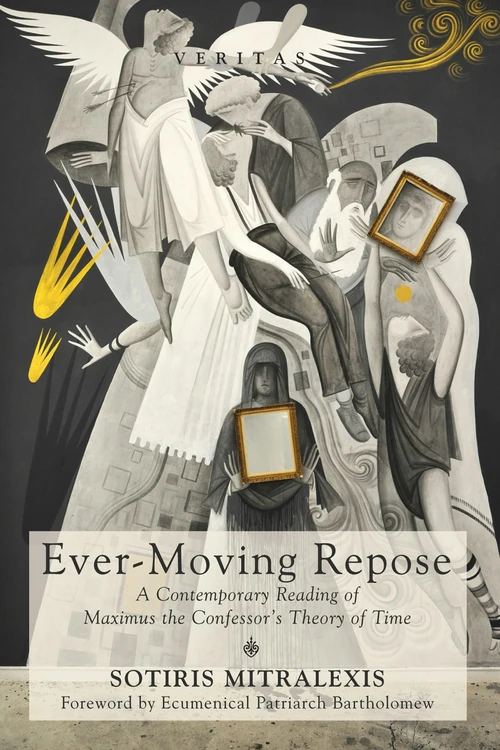
Ever-Moving Repose
A Contemporary Reading of Maximus the Confessor’s Theory of Time
- Theology
- Publisher: Cascade Books (Wipf and Stock)
- Published: 2017
FritzSearch.com earns a commission on purchases made through Bookshop.org links.
Publisher's Description
Sotiris Mitralexis offers a contemporary look at Maximus the Confessor's (580-662 CE) understanding of temporality, logoi, and deification, through the perspective of contemporary philosopher and theologian Christos Yannaras, as well as John Zizioulas and Nicholas Loudovikos. Mitralexis argues that Maximus possesses both a unique theological ontology and a unique threefold theory of temporality: time, the Aeon, and the radical transformation of temporality and motion in an ever-moving repose. With these three distinct modes of temporality, a Maximian theory of time can be reconstructed, which can be approached via his teaching on the logoi and deification. In this theory, time is not merely measuring ontological motion, but is more particularly measuring a relationship, the consummation of which effects the transformation of time into a dimensionless present devoid of temporal, spatial, and generally ontological distance--thereby manifesting a perfect communion-in-otherness. In examining Maximian temporality, the book is not focusing on only one aspect of Maximus' comprehensive Weltanschauung, but looks at the Maximian vision as a whole through the lens of temporality and motion.
Endorsements (4)
“In this remarkable book, Dr. Mitralexis seeks more than an exposition of a central notion in St. Maximus the Confessor's metaphysical vision, but rather a genuine fusion of the horizons, in a Gadamerian sense, so that his understanding of Maximus is informed by the development of a relational ontology by the likes of Zizioulas and Yannaras, whose own thought has been inspired by their reading of Maximus. The result is a bold and original contribution to ontology and metaphysics.”
“This book, written by a young and promising Maximus scholar, is an interesting study of a central set of notions in Maximus' writings, namely, the notions of time, the Aeon, and eternity. These notions have been studied by others as well, but never as extensively as by Mitralexis. He finds the roots of Maximus' notion of time in Aristotle, but has a quite original hermeneutical approach since he tries to unravel the Confessor's philosophy from the vantage point of the Greek modern philosopher Christos Yannaras, thus seeking to make Maximus' thought relevant for our own age. The depth of Mitralexis' knowledge of the sources and his grasp of modern scholarship on Maximus is impressive. I highly recommend this book.”
“This is a really welcome addition to the fast-growing literature on Maximus the Confessor. It is a first-class study of the original texts, but is distinctive in its willingness to bring Maximus' thought into fruitful conversation with contemporary philosophical discussions, so that the implications of this study will be of interest to many more than Byzantine specialists.”
See something wrong on this page? Report a problem