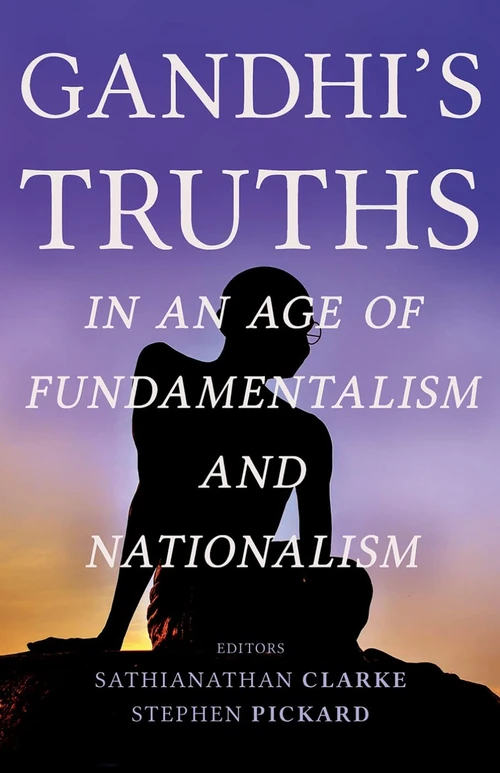
Gandhi's Truths in an Age of Fundamentalism and Nationalism
- Ethics, Culture & Social Issues
- Publisher: Fortress Press (Augsburg Fortress)
- Published: 2022
FritzSearch.com earns a commission on purchases made through Bookshop.org links.
Publisher's Description
The twenty-first century has seen violence thunder back onto the stage of history. Religious, political, social, cultural, and economic constituents and interests thus contribute to the local and global manifestations of violence in our interconnected and contracting global world. Firmly embedded within the field of religion, the authors of this volume concede that religious motifs and impulses are alive and well in this unfolding of bloodshed. It is no wonder then that in our volatile historical age, religious fundamentalism and illiberal nationalism have emerged as dominant contemporary movements. Against this backdrop, the contributors to this edited book look back in order to move forward by reflecting upon the truth-force (Satyagraha) that grounded and guided Mohandas Karamchand Gandhi (1869-1948). On the heels of several commemorations in 2019 of the 150th anniversary of Gandhi's birth, we reexamine the truths of his philosophy and nonviolent strategy to resist religious and political fundamentalisms. Embracing truth was, for Gandhi, the only way to achieve complete freedom (poorna Swaraj). The goal of freedom, which Gandhi conceptualized as profoundly personal, expansively communitarian, and organically ecological, emanates from a firm grasp of truth.
Endorsements (5)
“Praise for Gandhi’s Truths in an Age of Fundamentalism and Nationalism “A splendid effort to bring wisdom and sanity to a world mired in religious fundamentalism and hyper-nationalism. The book throbs with creative and critical reinterpretations of Gandhi’s Truth from the margins, directed to universal well-being.”
“Readers will not only learn new insights about Gandhi but will reconsider how we should approach truth. Clarke and Pickard bring together essays that illustrate the genius and strength of Gandhi’s pursuit of truth. What really sets this book apart is their insightful critique of Gandhi, making his message more relevant for today.”
“Gandhi’s ideas have informed and infuriated, inspired and irritated nationalists, social justice practitioners, scholars of religion and society, and those working on issues related to peace and human dignity. Without succumbing to hagiography, the authors of Gandhi’s Truth in an Age of Fundamentalism and Nationalism offer us much to interactively reflect upon and prudently put into practice in these messy and hazardous times. Ideas do travel, and ideas do return home, but they return transformed, and the contributors are to be commended for exploring Gandhi’s ideas from their own locations with bold frankness, knowledgeable thoughtfulness, and forward-looking engagement.”
“The collusion between the nation-state and religious fundamentalism arises in response to the loss of societal unity (pluralism) and the perceived absence of the sacred (secularism). All too often this results in violence against minorities; terrorism is its more extreme expression. This volume examines Mahatma Gandhi’s ethics of nonviolent resistance and commitment to existential truth as the pathway forward to dialogue, freedom, and peace. In so doing, it raises vital questions about the nature of religion and its role in being an opiate or a poison for our human and planetary future.”
“This is a remarkable and timely book for our age. Clarke and Pickard have brought together an exceptional group of writers who reflect on the legacy of Gandhi and what it means for us in the twenty-first century. Embedded in each essay are profound and searching questions concerning the future of humanity. Can we live with difference and disagreement? Can we forge genuine reconciliation across profound social, moral, religious, ethnic, and political divides? Can we turn the other cheek and refuse to pay back brutality and cruelty with violence of our own? This book will challenge the reader, but much more importantly, it offers us a future based on hope: one of kindness, compassion, and understanding. Now, more than ever, we need activists, politicians, and reformers who lead with a kindly light.”
See something wrong on this page? Report a problem