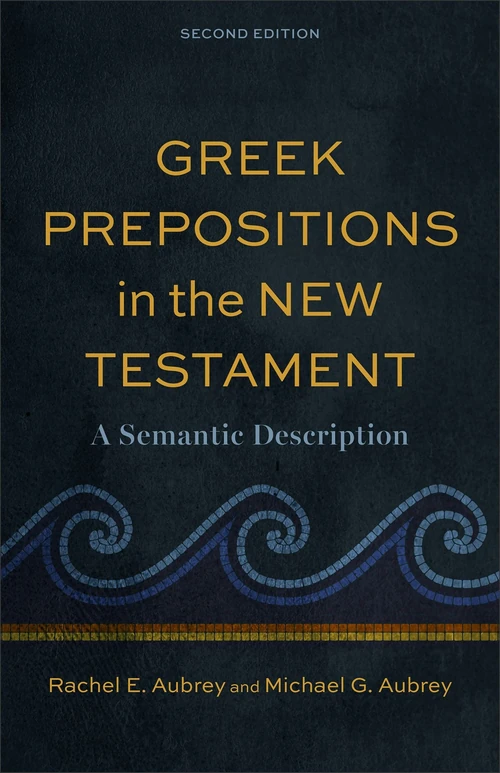
Greek Prepositions in the New Testament
- Biblical Studies & Commentaries
- Publisher: Baker Academic (Baker Publishing Group)
- Published: 2027
FritzSearch.com earns a commission on purchases made through Bookshop.org links.
Publisher's Description
The meanings of prepositions can be challenging to describe and understand, especially when one preposition is used in a variety of ways. A woman might hold an umbrella over her head while puzzling over a chess problem. She might also be over 100 years old. These kinds of variations in usage also occur in Greek. Grammatical differences among the world's languages and translation from one language to another only exacerbate such difficulties. Greek Prepositions in the New Testament takes a cognitive-functional approach, guiding readers through the diverse meanings and usage of prepositions found in biblical Greek. Each article illustrates a preposition's basic usage before detailing how these patterns are extended and adapted to take on more complex or abstract senses--with examples provided along the way. This book is an indispensable and user-friendly guide for students and scholars. It was previously available electronically, but due to demand, it is now in print for the first time. The second edition includes a new introduction and additional material.
Endorsements (5)
“Prepositions are some of the slipperiest words in Greek. And yet prepositions carry some of the most important theological expressions in the New Testament. I am grateful to the Aubreys for undertaking this meticulous and illuminating study of over forty major Greek prepositions from within the fresh framework of Cognitive Linguistics to help all of us get a better handle on this word group.”
“A significant breakthrough. I am eager to use this book in my Greek exegesis classes and my advanced Greek seminar. The conceptually clear presentation in this book will no doubt open up numerous biblical texts.”
“This book provides valuable insights from Cognitive Linguistics for Bible translation and interpretation from two linguists who really know their craft. It is readily accessible both to teachers and to students who have no background in linguistics but are keen to work with Biblical Greek. Highly recommended!”
“This book is both sophisticated and reasonably accessible, providing both scholars and students of the New Testament (including those translating it into various languages) with something much more valuable than a dictionary or lexicon: a semantic description that helps us understand not merely what prepositions might mean in various contexts but how and why they have such varied meanings. This book should be the first one anyone turns to in order to best understand what any preposition is doing.”
“This book is excellent--I cannot recommend it highly enough! Whether one is just starting to learn Greek or has been reading it for decades, this book is an indispensable resource. It will prove itself to be invaluable for years to come.”
See something wrong on this page? Report a problem