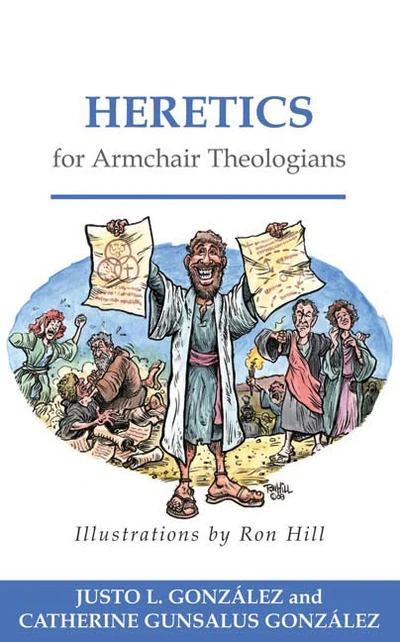
Heretics for Armchair Theologians
- History & Biography
- Publisher: Westminster John Knox
- Published: 2008
FritzSearch.com earns a commission on purchases made through Bookshop.org links.
Publisher's Description
In this unique Armchair volume, noted church historians Justo and Catherine Gonzalez introduce readers to important early church figures whose teachings were denounced by the church as heresies. Instructional for what they taught and for revealing what the church wished to safeguard and uphold, these “heretics,” including Marcion, Arius, Nestorius, and Pelagius, are engagingly presented in their contexts through a clear and accessible text that is highlighted by the humorous illustrations of Ron Hill. Heretics for Armchair Theologians is an enjoyable way to learn about the church’s early life and beliefs. Written by experts but designed for the novice, the Armchair series provides accurate, concise, and witty overviews of some of the most profound moments and theologians in Christian history. These books are essential supplements for first-time encounters with primary texts, lucid refreshers for scholars and clergy, and enjoyable reads for the theologically curious.
Endorsements (1)
“The Gonzálezes point out that heretics aren’t necessarily bad. Those they discuss in six chapters on persons and two on conceptual magnets for heresy, the Trinity and Christology, were earnest believers, and the church profited from arguing with them, even when it decided at last to excommunicate or, rarely, kill them. The topics they contested included whether or to what extent Jesus was divine (by the Ebionites and many later groups), the nature of creation (by gnosticism), whether Judaic law and scriptures should be observed and revered by Christians (by Marcion), what standards of behavior were appropriate to members of the church (by the Montanists), relations of church and state (by the Donatists), sin and free will (by Pelagius), the constituency of the Trinity, and the kind of divinity manifested by Jesus. Most of these matters are now primarily of historical interest (not gnosticism, however, as the popularity of Elaine Pagels and many New Age enthusiasms attest), but the Gonzálezes, aided by Ron Hill’s humanizing cartoons, make them lively again.”
See something wrong on this page? Report a problem