Ray Olson
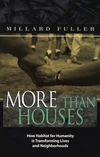
“Fuller's seventh book about Habitat for Humanity primarily tells the stories of people whose lives have been changed by its work. The stories' subjects include volunteer workers on the houses the world-spanning project builds and those who eventually occupied the "simple, decent" homes. Fuller presents the stories in thematic chapters on how Habitat's work has enhanced children's lives, transformed entire families, created neighborhoods, launched new careers, made friendships, bridged differences among participants, led to several marriages, etc. The intent of the book as a whole is to demonstrate that Habitat is building more than just houses. Habitat's "hundreds of thousands of volunteers, staff people, and homeowners," Fuller writes, "are truly, I think, an exciting part of building the kingdom of God on earth." The stories and Fuller's attitude attest that although Habitat is a forthright Christian endeavor, proselytizing is not part of its program, but recruiting your hands and building skills definitely are.”
Theology
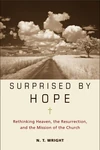
“Wright, the Anglican bishop of Durham, shares the strong current interest in Christian beginnings evidenced by the historical Jesus quest but points to faith, more than practice, more than dogma, as what most differentiates early from later Christians. Early Christians had faith in the Resurrection, that is, not only that Jesus rose from the dead in a new body but that they (indeed, everyone) would also rise from death in new bodies and into a new creation, not different but fulfilled, in which all would live fully and never die. That is what Christian hope consists in, and not in an afterlife in a distant heaven or hell, both of which domains are largely medieval fabrications popularized by a Florentine satirist, Dante. After explaining why we ought to believe objectively in Jesus’ literal resurrection, Wright argues that in his ministry resurrection is called the first fruits of the new creation because it demonstrated that the conditions of the new creation could be realized, however imperfectly, in the old, and by human agency. In the long run, Christian hope empowers and enjoins Christians to heal humanity and nature now, not to participate in general degradation through war, greed, and pollution.”
Surprised by Hope Bible Study Participant's Guide
Bible Studies & Devotionals
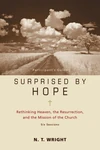
“*Starred Review* Wright, the Anglican bishop of Durham, shares the strong current interest in Christian beginnings evidenced by the historical Jesus quest but points to faith, more than practice, more than dogma, as what most differentiates early from later Christians. Early Christians had faith in the Resurrection, that is, not only that Jesus rose from the dead in a new body but that they (indeed, everyone) would also rise from death in new bodies and into a new creation, not different but fulfilled, in which all would live fully and never die. That is what Christian hope consists in, and not in an afterlife in a distant heaven or hell, both of which domains are largely medieval fabrications popularized by a Florentine satirist, Dante. After explaining why we ought to believe objectively in Jesus’ literal resurrection, Wright argues that in his ministry resurrection is called the first fruits of the new creation because it demonstrated that the conditions of the new creation could be realized, however imperfectly, in the old, and by human agency. In the long run, Christian hope empowers and enjoins Christians to heal humanity and nature now, not to participate in general degradation through war, greed, and pollution.”
The American Evangelical Story
History & Biography
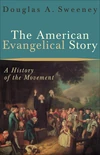
“Modern evangelicalism, the biggest thing in Protestantism since the Reformation, has influenced all Protestant denominations--indeed, it has generated most of them. Sweeney depicts it as a child of English Puritanism and German Pietism, born in the Great Awakening, which, inspired by the ideas of Massachusetts' Jonathan Edwards (1703-58), first broke out in John Wesley's England. Almost immediately, England dispatched the great George Whitefield (1714-70) to ensure that North America awoke, too. From then to the present, Sweeney traces evangelicalism's American lineage, proceeding chronologically. He treats each successive principal development: institution building, missionary endeavors, dealing with the infamous U.S. color line, the impacts of the late-nineteenth-century holiness and Pentecostal movements, and the twentieth-century emergence of fundamentalism and neoevangelicalism (it may surprise some to learn that evangelicalism and fundamentalism aren't synonymous). Definitions are made, distinctions drawn, and major figures sketched--all in nimble, unmannered, jargon-free prose that makes this the ideal book to read after, before, or in tandem with Wendy Murray Zoba's Beliefnet Guide to Evangelical Christianity (2005).”
Evangelism & Missions
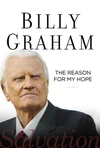
“Age and illness have removed him from the public eye, but only death will stop Graham from promulgating the same good news of salvation in Jesus Christ that he has preached now for 70 years. Only some of his exempla are new, drawn from recent headlines and the web, but, as always, Graham makes the message fresh, makes it new, in a plain-speaking and personal manner that few other evangelists have mastered quite as well. He remains absolutely faithful to the text of the Bible, as sure of sin and damnation as they are biblically portrayed as he is of repentance, salvation, and heaven. Moreover, he is as convinced of prophecy—that Jesus’ coming was foretold and that his Second Coming is certain—as ever. He doesn’t acknowledge nuance (although he doesn’t condemn metaphorical reading of scripture, either), and—what upsets contemporary sensibilities much more—he adheres to traditional understandings, for example of marriage, as firmly as to traditional evangelical interpretation of the Bible. He that hath ears to hear, let him hear.”
No books by this person in our catalog yet.
See something wrong on this page? Report a problem