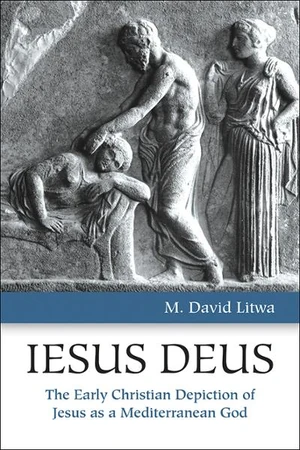
Iesus Deus
The Early Christian Depiction of Jesus as a Mediterranean God
- Theology
- Publisher: Augsburg Fortress
- Published: 2014
FritzSearch.com earns a commission on purchases made through Bookshop.org links.
Publisher's Description
What does it mean for Jesus to be “deified” in early Christian literature? Early Christians did not simply assert Jesus’ divinity; in their literature, they depicted Jesus with the specific and widely recognized traits of Mediterranean deities. Relying on the methods of the history of religions and ranging judiciously across Hellenistic literature, M. David Litwa shows that at each stage in their depiction of Jesus’ life and ministry, early Christian writings from the beginning relied on categories drawn not from Judaism alone, but on a wide, pan-Mediterranean understanding of deity.
Endorsements (2)
“In Iesus Deus, M. David Litwa surveys six of the more significant ways in which early Christians from the first through the third centuries CE drew on common reservoir of ancient Mediterranean conceptions of deity as models for expressing the ultimate significance of Jesus, namely his divine origin and deity. This is an extraordinarily well-written, nuanced, convincingly argued and methodologically sophisticated comparative study which breaks new ground in understanding a centrally important aspect of the formation of early Christology. The author makes use of an impressive array of primary and secondary sources over which he has enviable control. This book gets four stars and should be required reading for all serious students of early Christian thought.” —David E. Aune University of Notre Dame “M. David Litwa’s Iesus Deus marks a major breakthrough in scholarship on early Christianity. The book manages to overcome the scholarly apologetic segregation of early Christian beliefs about Jesus Christ from Greek and Roman dominated Mediterranean culture and to demonstrate the fit of these beliefs in that Hellenistic context. A great deal of writing about the ‘purely Jewish’ Christ crumbles with this book.”
“This book is of interest to a wide readership. It will help historical critics understand what ‘divinity’ meant in the ancient world. It will also help theologians understand the origins of Christology. I recommend it to students, scholars, and any reader curious about Jesus.”
See something wrong on this page? Report a problem