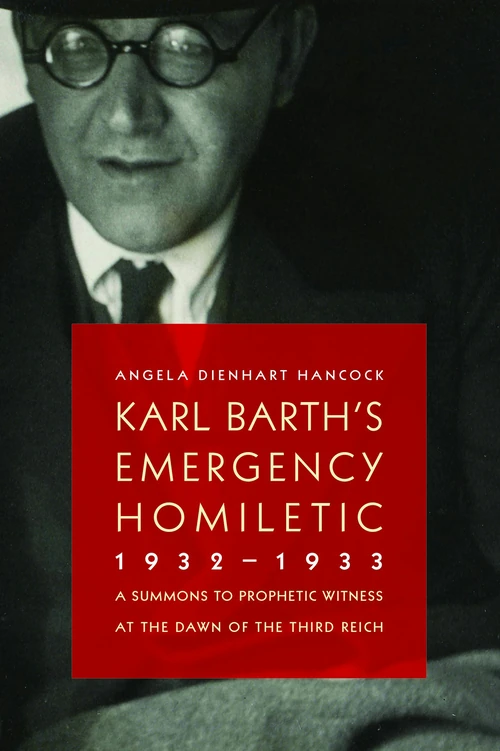
Karl Barth's Emergency Homiletic, 1932-1933
A Summons to Prophetic Witness at the Dawn of the Third Reich
- Theology
- Preaching & Worship
- Publisher: Eerdmans
- Published: 2013
FritzSearch.com earns a commission on purchases made through Bookshop.org links.
Publisher's Description
What does a theologian say to young preachers in the early 1930s, at the dawn of the Third Reich? What Karl Barth did say, how he said it, and why he said it at that time and place are the subject of Angela Dienhart Hancock's book. This is the story of how a preaching classroom became a place of resistance in Germany in 1932–33 -- a story that has not been told in its fullness. In that emergency situation, Barth took his students back to the fundamental questions about what preaching is and what it is for, returning again and again to the affirmation of the Godness of God, the only ground of resistance to ideological captivity. No other text has so interpreted Barth's "Exercises in Sermon Preparation" in relation to their theological, political, ecclesiastical, academic, and rhetorical context.
Endorsements (4)
“The question haunts us. How would I have responded to the rise of Nazism? Angela Dienhart Hancock, with careful scholarship and thorough research, examines the thinking of the dominant theologian of the twentieth century as National Socialism emerged around him. . . . Karl Barth's Emergency Homiletic is an ambitious, timely, and very important project.”
“On the basis of her careful and detailed research, Angela Hancock sets Barth's 'emergency homiletic' in the ominous political context of Germany in the early 1930s. The result is a moving account of Barth's efforts in his homiletics classes to liberate preaching from religious platitude and political propaganda and to present it instead as service of the living Word of God rooted in the biblical text and marked by expectancy, humility, and courage.”
“A splendid investigation of Karl Barth's homiletic seminar in 1932-33. . . . Angela Dienhart Hancock encourages us by her precise presentation to take the duty of preaching seriously.”
“Hancock's learned, perceptive, and compelling work adds significantly to our understanding of an important chapter of modern theology involving the twentieth century's most important theologian.”
See something wrong on this page? Report a problem