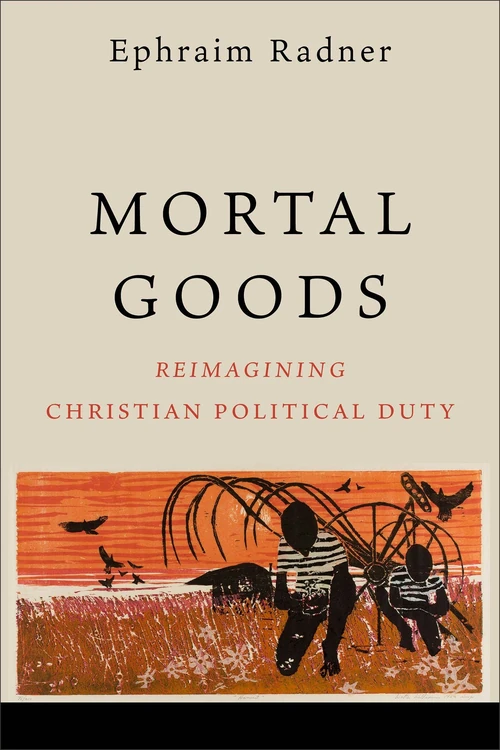
Mortal Goods
- Theology
- Ethics, Culture & Social Issues
- Publisher: Baker Academic (Baker Publishing Group)
- Published: 2024
FritzSearch.com earns a commission on purchases made through Bookshop.org links.
Publisher's Description
2025 Annual Word Awards Finalist (Academic)This book by one of today's leading theologians examines how Christians might more faithfully and realistically imagine their political vocation. Ephraim Radner explains that our Christian calling is to limit our political concerns to the boundaries of our created lives: our birth, parents, siblings, families, brief persistence in life, raising of children, relations, decline, and death. He shows that a Christian approach to politics is aimed at tending and protecting these "mortal goods" and argues for a more constrained view of our mortal life and our political duty than is common in both progressive and conservative Christian perspectives. Radner encourages us to take seriously what is most valuable in our lives and allow this to shape our social posture. Our vocation is to offer our limited life to God, give thanks for it, and glorify God by living our lives as a gift. Radner also shows how "catastrophe" reveals our time to be fragile, bounded, and easily overturned. And he exposes "betterment," which lies behind most modern politics, as a false motive for human life. The book concludes with a vision of the good life articulated in the form of a letter to his adult children.
Endorsements (4)
“Vintage Radner—erudite and incisive—with a twist: at times conversational and even personal. We find in Mortal Goods themes from Radner’s earlier volumes, here with new implications: the thresholds and limits of Christian political engagement, the ‘mortal goods’ that boundary our pilgrimage from birth to death. If you have not yet read Radner, start here. And if you have read him, continue with Mortal Goods.”
“Whether reflecting upon the scourge of pandemic, the spread of political violence, or the possibilities inherent to new digital technologies, many today narrate our age as ‘unprecedented.’ Yet, perhaps the insistence that human society faces disaster as never before exhibits how deeply we have become strangers to ourselves as mortal creatures. In Mortal Goods, Ephraim Radner shows how a wide spectrum of political and ecclesial viewpoints today treat calamity as a bug that mortals can fix rather than as a component of God-given creaturely life itself. Combining scholarly gravitas with a stark realism about the joys and sorrows of human life, Radner dares to peek under the veil of our self-congratulatory tales, testifying to God’s gracious work of redemption within our mortal limits. At once groundbreaking and deeply traditional, Mortal Goods is a wonder, a gift from one of the most creative theologians writing today. Whether or not one concurs with Radner’s conclusions, readers hungry for fresh insights on modern responses to mortal calamity will be deeply enriched by this volume.”
“the Christian Life “In a polarized age when edifying discussions about religion and politics are in short supply, Ephraim Radner asks us to rethink what we mean by ‘the good life.’ It begins with a self-imposed challenge to write a letter to his children about what makes life valuable. The letter he eventually pens, after pondering various God-given mortal goods (earthly gifts, like being part of a family, that constitute our brief lives in the world), is worth the price of the book—and has the potential to reorient, rehabilitate, and redeem our present political morass.”
“What is our Christian duty in public affairs? Many of us imagine that we’re called to put our shoulder to the wheel of progress. Radner argues otherwise. We are called to honor the beauty of creation and to ameliorate, as best we can, the burden of life after the fall. Supposedly high ideals are invitations to despair. Radner shows that we need a politics of finitude, one that is grateful and not grudging. Mortal Goods is a must-read in our difficult times.”
See something wrong on this page? Report a problem