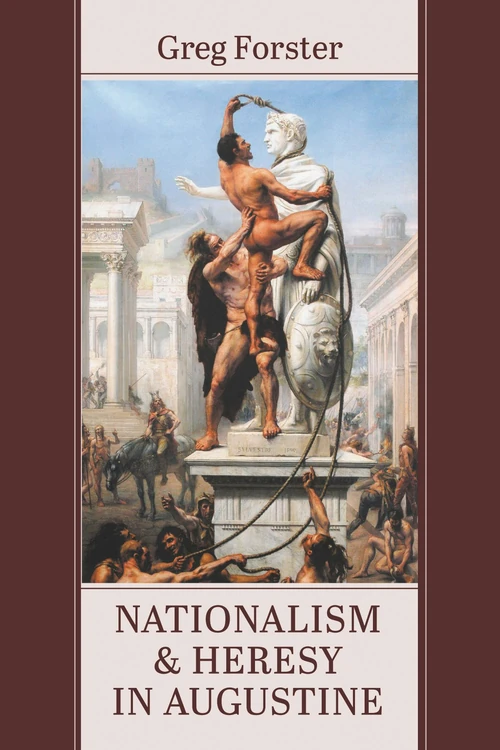
Nationalism and Heresy in Augustine
- Theology
- Ethics, Culture & Social Issues
- Publisher: Pickwick Publications (Wipf and Stock)
- Published: 2026
FritzSearch.com earns a commission on purchases made through Bookshop.org links.
Publisher's Description
Can nationalism be heresy? Augustine’s social thought resisted both the religious nationalism of those who saw Rome’s conquest of neighboring nations as God’s redemptive work, and the religious isolationism of the Donatist sect that rejected all Christian involvement in Rome’s public life. Augustine diagnosed both the nationalist and the isolationist temptation, not merely as unethical and imprudent, but as unorthodox and heretical—trusting in salvation by human works. His arguments against nationalism and isolationism mirror those he was using at the same time against the Pelagians; for Augustine, religious nationalism was missiological Pelagianism, while religious isolationism was ecclesiological Pelagianism. His writings against these two errors establish that fidelity to the gospel requires us to distinguish, but not separate, religious institutions and identities from political institutions and identities, creating a complex and ambiguous shared space within which the city of God and the worldly city engage in spiritual struggle. This fresh and innovative look at Augustine’s social thought, from an interdisciplinary perspective that draws on theology and social science, speaks directly to questions that are urgent in every age of the church, including our own.
Endorsements (3)
“Greg Forster has written a solid account of Augustine’s works on the relation of theology and political governance. He has penned a well-crafted argument critically surveying both the primary texts and relevant works of Augustinian scholars in a concise and astute manner. But Forster has written more than a text on church history. He uses an Augustinian framework to evaluate contemporary Christian political theology. His conclusion is provocative, namely, that heretical theology is a fertile field for bad politics, both in Augustine’s day and our own.”
“Greg Forster has produced a first-rate work of scholarship on Augustine and his relevance to our political context today. He brings together his expertise in both theology and political philosophy ably and provides a very helpful resource for future work. Readers may disagree with Forster in places, but overall, this is a superbly documented and well-argued work. Highly recommended.”
“Relating to culture is tricky. One can assimilate to it, identify with it and hold it with efforts at maintaining status through power for ‘my’ group, or isolate from it. In the process, one loses the ability to function in the mission God gave the church. Forster’s detailed study of Augustine uses the lessons of history to guide us into thinking about the uniqueness of the church and the dangers of connecting to any of these choices in such a way that nationalism undercuts the trans-national nature of the church. God’s desire for all the nations and the common good shines through as does the need to be sure the church functions independently of the world’s search for power and control. This is a book that repays a careful read and I commend it with enthusiasm.”
See something wrong on this page? Report a problem