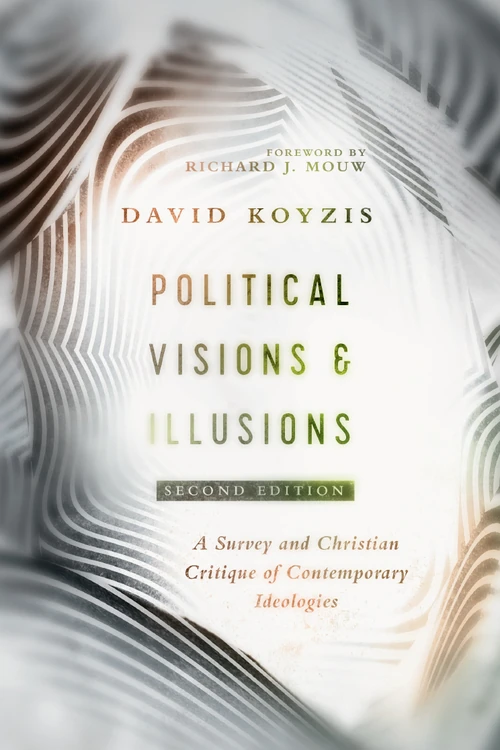
Political Visions & Illusions
A Survey & Christian Critique of Contemporary Ideologies
- Ethics, Culture & Social Issues
- Publisher: IVP Academic (InterVarsity Press)
- Published: 2019
FritzSearch.com earns a commission on purchases made through Bookshop.org links.
Publisher's Description
Named Best Book (Culture) in the 2004 Word Guild Canadian Writing Awards The end of the Cold War has brought about more than the triumph of some political ideologies and the disappearance of others. In fact, the collapse of communism has created a vacuum quickly being filled by various alternative visions, ranging from ethnic nationalism to individualistic liberalism. But political ideologies are not merely a matter of governmental efficacy. Rather,political ideologies are intrinsically and inescapably religious --each carries certain assumptions about the nature of reality, individuals and society, as well as a particular vision for the common good. These fundamental beliefs transcendthe political sphere, and the astute Christian observer should thus discern the subtle ways in which ideologies are rooted in idolatrous worldviews. In this comprehensive study, political scientist David Koyzis surveys the key political ideologies ofour era, including liberalism, conservatism, nationalism, democracy and socialism. Each philosophy is given careful analysis and fair critique, unpacking the worldview issues inherent to each and pointing out essential strengths and weaknesses. Koyzis concludes by proposing alternative models that flow out of Christianity's historic engagement with the public square, retrieving approaches that hold promise for the complex political realities of the twenty-first century. Writing with broad, international perspective and keen analytical insight, Koyzis offers a sound guide for Christians working in the public square, culture watchers, political pundits and all students of modern political thought.
Endorsements (7)
Foreword
“David Koyzis not only helps us to see the basic worldviews that give shape to a variety of political perspectives, he also makes a solid case for a uniquely Christian perspective on these matters. This excellent book is a much-needed 'discerning' tool for understanding the basic issues of political life.”
“David Koyzis has produced a truly original book illuminating the landscape of modern political ideologies. His approach is distinctively Christian, giving him a standpoint from which to cririque liberal as well as totalitarian ideologies. Moreover, the book is up to date with the post-Cold War world. This is the place to start for anyone who wants to understand the dynamics of ideological conflict in the world today.”
“Thankfully it is now common for Christians to believe that the gospel should shape our view not only of the goals but also of the nature of our politics, and that the theme of idolatry is key to understanding not only our personal but also our political life. But until David Koyzis's Political Visions and Illusions, this understanding has remained largely vague, tentative and intuitive. This book shows clearly and in detail how biblical insight into idolatry and ideology illuminate the most concrete dimensions of political life in a way rarely grasped by more secular political scientists.”
“Few could have anticipated the major political upheavals witnessed since this book first came out in 2003. Yet Koyzis's book has stood the test of time, ranking, in my opinion, as the best introduction to modern political thought from a Christian perspective. This updated edition is welcome in its inclusion both of newer literature and fresh examples to recent political developments. As a politically engaged theologian, I'm especially thrilled to see the addition of the 'Concluding Ecclesiological Postscript' that could very well serve as kind of theo-political compass for church leaders wanting navigational guidance on how churches should—and should not—engage in political action.”
“Political nostrums fly thick and fast in contemporary life--from print, radio, TV, pulpits and (perhaps most of all) casual conversation. David Koyzis's welcome effort uses wise biblical reasoning as well as the hard-won experience of Dutch Calvinists to winnow through the modern world's blizzard of competing politcal claims. Koyzis's analysis is both an effective survey of the world's contemporary political options and an encouraging Christian word on how to discern the critical differences. This book's combination of readable theory and wise Christian thinking is a first-order contribution to Christian political thought in its own right.”
“Koyzis offers an accessible, compelling, and deeply researched introduction to the major political ideologies at work in the world today. Throughout the book Koyzis serves the reader as a faithful and thoughtful Christian guide through the many competing political voices active in the public square. I've been assigning Political Visions and Illusions in my courses on faith and politics for years now, and I'm so grateful for a new and updated edition. It is a true gift.”
“Although the first edition of Political Visions and Illusions has already been praised in Brazil as an invaluable tool of Christian political formation, from young students and clergy to federal prosecutors and career politicians, the new edition confirms itself as a classic. The author deepens the conversation of ideology and idolatry, recovering the central role of narrative for ideology. He greatly enhances his explanation and extracts the equivalents of the biblical creation/fall/redemption/consummation narrative ingrained within the core stories of liberalism, conservatism, nationalism, democratism, and socialism. Dr. Koyzis also updates his approach by engaging novel critiques of those ideologies, such as Patrick Deneen’s on liberalism; listening to relevant Christian political thinkers, such as David L. Schindler; and introducing new insights of his own, such as his theory of authority. The new edition of Political Visions and Illusions carries the promise to be an even greater blessing for the Christian political mind. I hope we will have it in Portuguese soon.”
See something wrong on this page? Report a problem