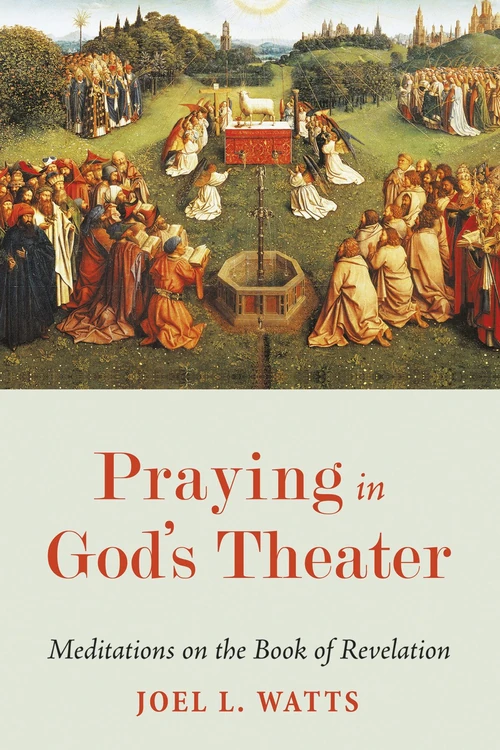
Praying in God’s Theater
Meditations on the Book of Revelation
- Prayer & Spiritual Formation
- Publisher: Wipf and Stock
- Published: 2014
FritzSearch.com earns a commission on purchases made through Bookshop.org links.
Publisher's Description
Much like the book of Revelation, Joel L. Watts' Praying in God's Theater aims to pull readers into a deeper spirituality to confront the daily struggles of Christian life. Drawing from the rich well of Christian mystics and theologians from across the ecumenical experience, Watts uses the Apocalypse to build a series of prayers and devotions aimed at increasing what he identifies as the contemplative unity and the certain unity between the individual and Christ. He urges a radical vision of the prayer and the sacrament of the Eucharist. Each chapter of Revelation is considered, explored, and finally used as a basis to draft prayers. Added to this is an application commentary that explores ancient liturgical practices similar to the scenes in Revelation while looking at Revelation in a mystical manner. Watts offers Revelation as an early liturgy, using this proposition as a catalyst for building prayers and a vision of life based on the Eucharist as the emblem of how we are to approach God. What emerges is a profound view on how we envision Scripture, prayer, and the book of Revelation.
Endorsements (2)
“Revelation is, at its heart, about mysteries. Such things are best approached in prayer, in an attitude of worship, and in conversation with wiser souls. Joel L. Watts's approach does exactly that, weaving a mix of liturgical prayer and scholarly reflections together with insights from commentators both ancient and modern.”
“Watts has written a beautiful, creative, and informative book on John's Apocalypse. Watts' attention to the full landscape of the book of Revelation, coupled with his attention to multiple interpretive traditions, is commendable. This book will serve faith communities and university students alike. It deserves careful attention.”
See something wrong on this page? Report a problem