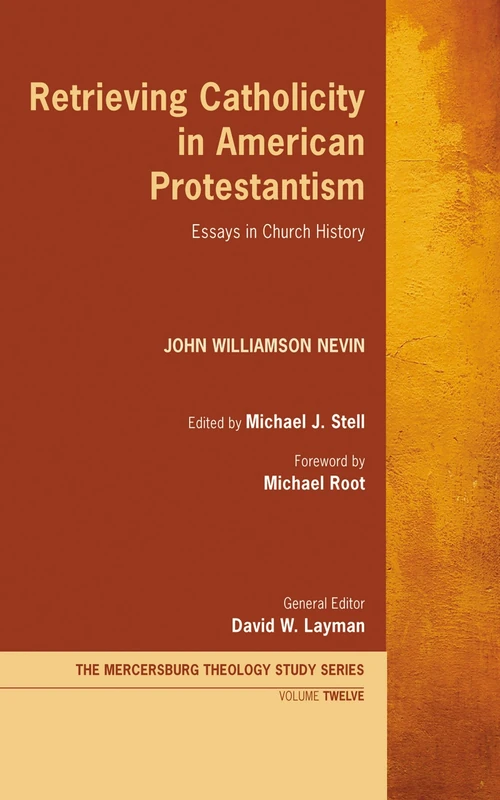
Retrieving Catholicity in American Protestantism
Essays in Church History
- History & Biography
- Publisher: Wipf and Stock
- Published: 2024
FritzSearch.com earns a commission on purchases made through Bookshop.org links.
Publisher's Description
This volume is a collection of essays on church history by John Williamson Nevin (1803-86), the theological creator of Mercersburg Theology. Nevin and his colleague Philip Schaff were attempting to reorient American ecclesial thought to be more historical. Most American theologians of the period posited a period of spiritual decline soon after the New Testament, lasting until the Protestant Reformation. They believed the ongoing task of the children of the Reformation was to remake the church in the mold of the apostolic faith. In these essays, Nevin was seeking to establish a more unified historical narrative that saw the Reformation as an essential outgrowth of the medieval Catholic church. Nevin's search for an answer to the church question--what is the church?--demanded a focus on history as an unfolding, teleological journey. Nevin's search for history is part of his larger search for catholicity in the American Protestant church. These writings are an important part of the larger theological project that is known as Mercersburg Theology, which is being explored in the volumes of this series.
Endorsements (5)
“John Williamson Nevin thought deeply throughout the latter part of his career about the theological meaning of history and the theoretical foundations of historical writing. Michael J. Stell’s masterly editing enables us to see the changes and continuities in Nevin’s thinking about historical development. A critical but appreciative interpreter of German philosophical idealism, Nevin challenged the philosophical assumptions of the nineteenth-century denominational histories and called for a broader view of history within American churches. His challenge echoes even today.”
“In this collection of essays, John Williamson Nevin advances a theory of historical development and insists upon the intimate connections between Roman Catholic precedent and contemporary Protestant practice. The volume is graced with a meticulous introduction by editor Michael J. Stell, who also provides concise prefaces to each individual section of the book. With Nevin’s insistence upon what really happened over against a self-serving lore, these essays contribute to ongoing debates about what is real and what is fake.”
“Michael J. Stell’s meticulously and judiciously edited volume illumines the uniqueness of John Williamson Nevin’s theology of history. These essays by Nevin show how he challenged prevailing nineteenth-century American assumptions about the disjunction of Protestantism and its Roman Catholic ancestry. Nevin’s writings subverted Protestant myths of a faithful remnant of true Christians that finally became overt and blossomed during the Reformation era. Critically using some of the methods of German historiography, Nevin paved the way for a more ecumenical appreciation of the evolving nature of Christian traditions.”
“As a theological and historical reality, the nature of the church necessarily provokes reflection on the theology of history itself, including the complex phenomenon of theological development. It may in fact be here where John Williamson Nevin’s lively and vigorous work is most timely for us today, for the recent revival of interest in Reformed catholicity—if it is to be effective in remedying the dangers of both historicism and biblicism—must advance a robust theology of Scripture in relation to the church. For this reason and others, the appearance of this latest collection of Nevin’s writings is not only most welcome but also a summons to press on in the exploration of questions that remain as fresh and important as ever.”
See something wrong on this page? Report a problem