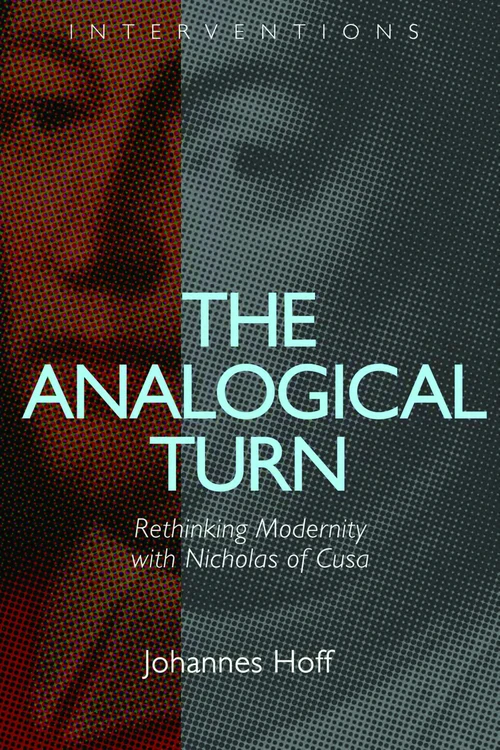
The Analogical Turn
Rethinking Modernity with Nicholas of Cusa
- Philosophy
- Theology
- Publisher: Eerdmans
- Published: 2013
FritzSearch.com earns a commission on purchases made through Bookshop.org links.
Publisher's Description
Recovers a 15th-century thinker’s original insights for theology and philosophy todaySocieties today, says Johannes Hoff, are characterized by their inability to reconcile seemingly black-and-white scientific rationality with the ambiguity of postmodern pop culture. In the face of this crisis, his book The Analogical Turn recovers the fifteenth-century thinker Nicholas of Cusa’s alternative vision of modernity to develop a fresh perspective on the challenges of our time. In contrast to his mainstream contemporaries, Cusa’s appreciation of individuality, creativity, and scientific precision was deeply rooted in the analogical rationality of the Middle Ages. He revived and transformed the tradition of scientific realism in a manner that now, retrospectively, offers new insights into the “completely ordinary chaos” of postmodern everyday life. Hoff’s original study offers a new vision of the history of modernity and the related secularization narrative, a deconstruction of the basic assumptions of postmodernism, and an unfolding of a liturgically grounded concept of common-sense realism.
Endorsements (4)
“The Analogical Turn by Johannes Hoff for the first time locates Nicholas of Cusa without anachronism as a post-nominalist realist, who reworked the inherited analogical vision of Christian theology in a simultaneously late Gothic and Renaissance manner. As Hoff explains, this idiom offers us a new way forward today. . . . Much more than a monograph on a historical figure, this imaginatively crafted and extremely scholarly volume constitutes one of the most significant works of theology in the twenty-first century so far. I believe that it will exert a very considerable influence on future theoretical reflections both within theology and without.”
“In this fascinating book Johannes Hoff shows us how Nicholas of Cusa sought to express the insights of the classical and medieval worldview in the conceptuality of the modern. With enormous learning and great insight, Hoff's Analogical Turn illuminates some of the urgent problems of philosophy and theology today.”
“With The Analogical Turn: Rethinking Modernity with Nicholas of Cusa Johannes Hoff has given us the most challenging and most readable book on the fifteenth-century cardinal to have appeared in English. But, as the title suggests, at issue is much more -- the shape and fate of our modern world. Recently there has been much talk about this being a postmodern, postsecular age. Hoff's book should make such talk more thoughtful.”
“This work by Johannes Hoff crucially enhances our understanding of the origins of modernity in the late Middle Ages. . . . He shows how the fragmented and illusory modern world in which we live was not an inevitable outcome of the cultural and intellectual upheavals of the fourteenth and fifteenth centuries. There is an alternative modernity, centered on a theological symbolic reality, which can be derived chiefly from the work of fifteenth-century theologian, philosopher, and mathematician Nicholas of Cusa. There is a way of radically rethinking our modern cultural and intellectual malaise. This is scholarship of the very highest caliber. Hoff's book will establish itself as one of the most significant works of Christian theology and philosophy in recent years.”
See something wrong on this page? Report a problem